

Quick Answer: The most corrosion-prone components on a saltwater boat are the outboard lower unit, trailer frame and hubs, electrical connections and grounds, stainless steel hardware at fastener points, and any location where two dissimilar metals contact each other. Each fails through a different corrosion mechanism, and each requires a specific protection approach to interrupt the process before damage becomes irreversible.
Salt corrosion on a boat is not random. It follows predictable patterns driven by material properties, design geometry, and electrochemical principles that have been well understood for decades. The components that fail first on Gulf Coast boats fail first for specific, knowable reasons. Understanding those reasons is the first step toward protecting the right things in the right order.
This article goes component by component through the highest-risk areas on a saltwater boat, explains the corrosion mechanism operating at each location, and describes what effective protection looks like in practice.
How Saltwater Corrodes Different Materials Differently
Before breaking down individual components, it helps to understand that saltwater does not corrode everything the same way. There are three primary corrosion mechanisms at work on a typical saltwater boat, and most components fail through one of them:
- Uniform corrosion: The surface material oxidizes evenly across an exposed area. This is what happens to unprotected steel when it rusts. It is visible, gradual, and predictable.
- Galvanic corrosion: When two dissimilar metals are in electrical contact in a salt water environment, the less noble metal corrodes preferentially. This is why aluminum corrodes where it contacts stainless steel, and why anodes are installed to sacrifice themselves in place of more valuable components.
- Crevice corrosion: In tight spaces where salt water is trapped and oxygen is depleted, the passive protective layer on metals like stainless steel breaks down and rapid localized corrosion occurs. This produces the rust staining seen around stainless fasteners even though the exposed stainless surface appears clean.
Salt accelerates all three mechanisms by providing the electrolyte that enables electrochemical reactions. Remove the salt, and you slow all three processes simultaneously.
Component 1: Outboard Lower Unit
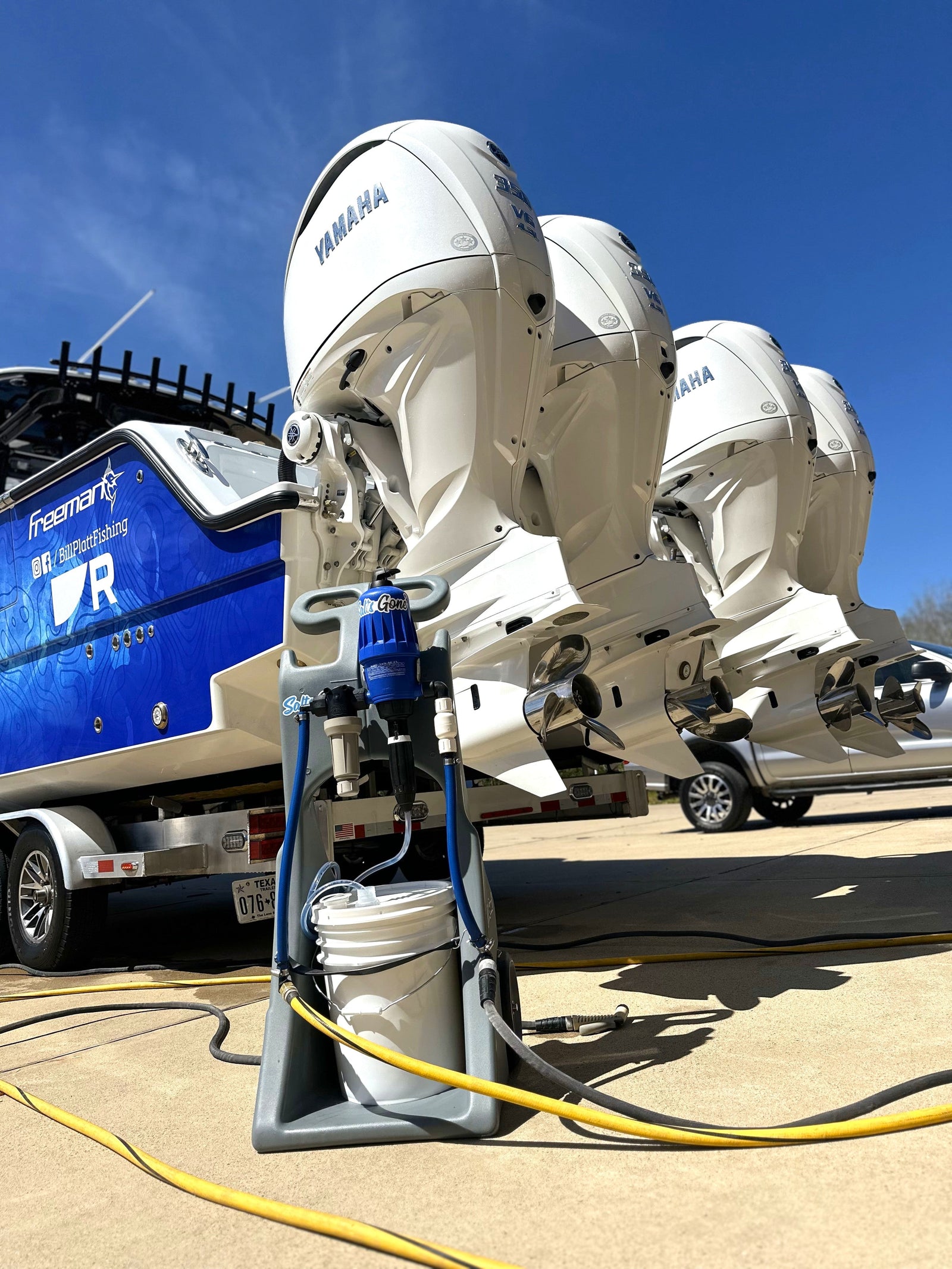
The lower unit is the highest-risk component on most saltwater boats for several compounding reasons. It is made of aluminum, which is susceptible to galvanic corrosion. It is constantly submerged during operation. It houses stainless steel components including the prop shaft, fasteners, and shift rod, creating galvanic couples with the aluminum housing. And it is subjected to prop wash that continuously removes any natural protective film that might otherwise form on the aluminum surface.
Galvanic corrosion between the aluminum housing and stainless internal components is the primary failure mechanism. Sacrificial anodes are installed specifically to address this, but anodes have a finite capacity and deplete faster under high-use conditions in warm, high-salinity Gulf water. A 50% depleted anode provides roughly half the galvanic protection the system was designed for.
Protection approach:
- Inspect anodes at every service and replace at 50% depletion or sooner during heavy-use seasons
- Apply chelation-based salt removal to the entire lower unit exterior after every saltwater trip, before the unit dries
- Pay specific attention to the area around the prop shaft seal and trim tab mounting points, where salt accumulates in crevices
- Flush the cooling system with fresh water after every operation to remove salt from internal passages
Component 2: Boat Trailer Frame and Running Gear
The trailer is submerged in salt water at every ramp launch and retrieval, making it one of the most salt-exposed components in the system and one of the most frequently neglected. Trailer frames are typically either galvanized steel or aluminum. Both resist corrosion significantly better than bare steel, but both have failure points.
Galvanized steel frames corrode first at weld points, where the zinc galvanization is thinnest and where heat from welding has altered the metal's microstructure. Any chip, scratch, or abrasion in the coating exposes bare steel that corrodes rapidly in a saltwater environment. Trailer frames in heavy use on Texas coast ramps can show significant frame corrosion within two to three seasons if surface protection is not maintained.
Trailer hubs and wheel bearings represent a specific failure risk. Salt water intrudes past hub seals during ramp submersion, contaminating the grease that protects bearings. Contaminated grease loses its lubricating properties and accelerates bearing wear. Bearing failure on a loaded trailer at highway speed is a safety event, not just a maintenance issue.
Trailer wiring harnesses corrode where connections are exposed to salt water, creating resistance that causes intermittent lighting failures. A ground connection corroded enough to cause a lighting failure is one that has been building resistance for weeks before it fails completely.
Protection approach:
- Treat the trailer at the ramp immediately after loading, before salt deposits dry on the frame
- Apply chelation-based product to the entire frame, hubs, and any accessible wiring connection points
- Inspect hub seals annually and after any submersion deeper than normal, replacing at the first sign of seal degradation
- Service wheel bearings on a defined schedule, not on a wait-for-failure basis
- Inspect the frame at weld points and any area that shows coating damage, applying touch-up coating before corrosion establishes
The SaltsGone trailer care guide covers the most effective application technique for trailers in detail, including how to reach the areas that generic spraying misses.
Component 3: Electrical System and Grounds
Marine electrical corrosion is the failure mode that most often surprises boat owners because it is invisible until it causes a problem. Corroded connections do not look dramatically different from clean ones to the casual eye. They look slightly dull, possibly with a faint green or white powder at the terminal, until the resistance they have built up causes a component to stop working.
The marine electrical environment is inherently corrosion-prone because it combines two of the three requirements for galvanic corrosion: dissimilar metals (copper wire, tin-plated terminals, stainless fasteners) and an electrolyte (salt water). The only thing standing between a functioning electrical system and active galvanic corrosion at every connection point is the absence of salt water. Once salt water gets into a terminal, the corrosion process begins.
Stray current corrosion is a related and more aggressive failure mode found on boats with electrical issues. When current leaks from the DC system through the salt water surrounding the boat rather than through the intended wiring path, it accelerates corrosion on submerged metal components dramatically. A boat with a stray current problem can lose an outboard lower unit in weeks rather than years.
Protection approach:
- Apply dielectric grease to all accessible electrical connections, including battery terminals, bilge pump wiring, and navigation light grounds
- Inspect and treat electrical connection points as part of the post-trip salt removal routine
- Test for stray current with a multimeter if unexplained corrosion is occurring on submerged components. A marina electrician can perform a full stray current survey if a problem is suspected.
- Use marine-grade wiring and connectors in any electrical repair. Automotive-grade wiring does not have the corrosion resistance to hold up in a marine saltwater environment.
Component 4: Stainless Steel Hardware
Stainless steel has a reputation for corrosion resistance that is well-earned in many environments but frequently misunderstood in the marine context. Stainless resists corrosion through a passive chromium oxide layer that forms spontaneously on the surface when exposed to oxygen. In an open, oxygen-rich environment, this layer is self-repairing and provides excellent protection.
The problem is crevice corrosion. In any tight space where salt water is trapped and oxygen cannot circulate, the passive layer cannot maintain itself. The metal beneath it corrodes rapidly in the confined environment. On a saltwater boat, every fastener hole, every through-deck fitting, every hinge point, and every place where a fitting sits against a surface creates this low-oxygen crevice environment.
The rust staining that appears around stainless T-top fasteners, rod holder bases, rub rail screws, and grab rail mounts is crevice corrosion. The stainless surface that is visible and exposed to air looks fine. The stainless inside the fastener hole or behind the fitting is actively corroding.
Protection approach:
- Use Tef-Gel, Lanocote, or similar anti-seize compound on all stainless fasteners during installation to exclude salt water from the fastener-to-fitting interface
- Inspect through-deck and through-hull fittings annually for signs of crevice corrosion, which appears as rust staining radiating outward from fastener points
- Apply chelation-based salt removal to all stainless hardware surfaces, particularly around fastener points and fitting bases where salt accumulates
- Replace fasteners showing significant crevice corrosion before they seize in place or shear during removal
Component 5: Gelcoat and Hull Above the Waterline
Gelcoat is not metal and does not corrode in the electrochemical sense. But salt, UV, and the interaction between them degrades gelcoat in ways that create vulnerability to the corrosion processes operating on the metal components beneath and around it.
Salt deposits on gelcoat pull moisture from Gulf Coast air and hold it against the surface. UV degrades the surface layer of gelcoat, creating micro-cracks and pores that provide entry points for salt and moisture into the substrate below. On an older boat or one that has lost its wax protection, salt penetration into degraded gelcoat accelerates chalking, oxidation, and eventually cracking that allows moisture and salt to reach the fiberglass laminate below.
Salt water that reaches the fiberglass laminate creates the conditions for osmotic blistering, where moisture trapped within the laminate causes structural blistering of the hull. This is an expensive repair that begins with conditions that regular salt removal and surface protection directly address.
Protection approach:
- Remove salt from hull surfaces after every trip to prevent concentration during drying
- Maintain wax or ceramic coating protection on all gelcoat surfaces, replacing before protection is fully depleted
- Compound and polish oxidized areas before they become structurally compromised
- Inspect the hull annually for osmotic blistering, particularly in areas near the waterline
Component 6: Bilge and Enclosed Interior Spaces
The bilge is a salt accumulation environment that most boaters underestimate. Every bait well, livewell, and bilge pump cycle moves salt water through enclosed spaces that dry slowly, have limited ventilation, and are difficult to rinse thoroughly. Salt that accumulates in the bilge creates a persistently corrosive environment for any metal component in that space.
Bilge pump motors, wiring harnesses, and through-hull fittings in the bilge are all in one of the harshest corrosion environments on the boat. Bilge pumps that are submerged in salt water regularly fail faster than the same pump in a freshwater environment not because of mechanical wear but because of salt corrosion on the motor housing, terminals, and float switch components.
Protection approach:
- Flush the bilge with fresh water after every saltwater trip, directing the bilge pump to clear salt-contaminated water
- Inspect bilge pump terminals and float switch connections regularly for early corrosion signs
- Treat accessible bilge metal surfaces with corrosion inhibitor spray after each season flush
Texas Gulf Coast Conditions: Why Corrosion Runs Faster Here
The corrosion mechanisms described above operate everywhere saltwater boats are used. On the Texas Gulf Coast, several environmental factors accelerate them beyond what boaters in other regions deal with:
- Gulf of Mexico salinity runs slightly above the global ocean average, providing a more aggressive electrolyte
- Summer water and air temperatures in the upper 80s and 90s Fahrenheit accelerate electrochemical reaction rates
- Gulf Coast humidity keeps salt deposits electrochemically active between trips rather than allowing them to dry and become less reactive
- Peak boating season overlaps with hurricane season, adding storm surge and concentrated salt spray events to normal exposure
These conditions mean the protection intervals that work for recreational boaters in other climates are not adequate for Gulf Coast use. Post-trip treatment after every outing is not optional on this coast. It is the minimum standard for protecting a significant investment in a genuinely demanding environment. See how salt damage progresses on offshore boats specifically at the SaltsGone offshore boat salt damage guide.
SaltsGone: Protection Designed for Every Component on This List
Covers every material on every component. The lower unit is aluminum. The hardware is stainless. The trailer is galvanized steel. The hull is gelcoat over fiberglass. The electrical connections are copper and tin. SaltsGone is pH-neutral and safe on all of them in a single product. One application routine covers every component on this list without switching products or worrying about compatibility. Visit the marine application page for the full surface coverage breakdown.
Chelation removes salt, not just moves it. The goal of treating every component on this list is to remove the salt that is driving corrosion, not to temporarily dissolve and redistribute it. SaltsGone's chelation chemistry captures sodium and chloride ions and removes them permanently when the surface is rinsed. Discover the full science at saltsgone.com/pages/how-it-works.
Protective barrier after every application. After rinsing, SaltsGone leaves a corrosion-inhibiting layer on treated surfaces. This layer slows the rate at which new salt deposits from the next trip can begin driving corrosion, providing coverage between applications on every component that was treated.
Economical enough to use every trip. At a 1:100 dilution ratio, the cost per application is low enough that using SaltsGone after every outing during a full peak season is not a budget concern. The alternative, repairing the components on this list, runs into hundreds to thousands of dollars per item. Explore the full product line at saltsgone.com/collections/salts-gone.
Frequently Asked Questions
How do I know if my lower unit has galvanic corrosion versus just surface oxidation?
Surface oxidation on aluminum appears as a white or gray powdery film on the exterior surface and is often uniform across exposed areas. Galvanic corrosion tends to be more localized, appearing as pitting concentrated near dissimilar metal contact points, around fasteners, or near the trim tab mounting area. If pitting is present rather than surface film, galvanic corrosion is the more likely mechanism. Anode inspection at the same time will often show accelerated depletion, which confirms galvanic activity.
Should I use a different product for stainless steel versus aluminum versus the trailer frame?
No. SaltsGone is pH-neutral and compatible with all of these materials in a single product. Using separate products for different materials adds complexity and introduces compatibility risks. The same chelation chemistry that captures salt ions on aluminum captures them on stainless and galvanized steel without any surface-specific adjustment needed.
My trailer already has visible surface rust on the frame. Is it too late to start treating it?
Surface rust that has not penetrated significantly into the metal can be stabilized by removing the active salt environment driving it and applying a rust converter to address what has already formed. Starting a consistent salt removal routine after treating existing rust stops the progression. Treating existing rust and then protecting with regular SaltsGone application extends the service life of a frame that would otherwise continue degrading through the remainder of the season and into the next one.
How often should I replace anodes on a boat used heavily on the Gulf Coast?
The standard guideline of annual anode replacement assumes moderate use in average conditions. A boat running multiple trips per week through Gulf Coast summer should have anodes inspected every 60 to 90 days during peak season and replaced at 50% depletion. An anode that is half-consumed provides roughly half the galvanic protection the system needs. Waiting until the anode is fully depleted means the component it was protecting has been underprotected for weeks.
Can I use SaltsGone directly on the outboard motor while it is still hot from running?
Allow the motor to cool to a temperature that is warm but not hot to the touch before applying SaltsGone. Applying any liquid product to a very hot motor surface causes rapid evaporation that reduces contact time and effectiveness. A motor that has been out of the water for 15 to 20 minutes in Gulf Coast ambient temperatures is typically at an appropriate temperature for treatment. Applying while the motor is still wet from operation is ideal if the surface temperature allows it.


