

How Salts Gone® Works -
The Science Behind Salt Removal
Salts Gone® eliminates salt at a molecular level through chelation. Rusts Gone converts existing rust into a stable, protective compound. Together, they form the ultimate corrosion management solution.
How Salts Gone® & Rusts Gone Work Together
A complete two-step system for eliminating salt damage and reversing existing rust — protecting your investments for years.
Identify
Inspect your vehicle, boat, or equipment for white salt deposits, brown rust stains, or hidden corrosion under panels, on undercarriages, and around hardware.
Apply Salts Gone®
Spray Salts Gone® on all surfaces. Chelating agents bond to sodium and chlorine ions, breaking salt apart at a molecular level and removing it completely.
Apply Rusts Gone
For existing rust and oxidation, apply Rusts Gone directly to affected areas. The tannic acid formula converts iron oxide into a stable, protective compound.
Protected
Salts Gone® leaves a light corrosion-inhibiting film that resists future salt adhesion. Rusts Gone's iron tannate layer seals the metal against moisture and oxygen. Together, your surfaces are fully protected.
Chelation + Conversion Technology
Two scientifically proven mechanisms working together to eliminate corrosion at every stage.
Chelating Agents (Salts Gone®)
Chelating molecules form coordinate bonds with sodium and chlorine ions, sequestering them into stable, water-soluble complexes that rinse away completely — preventing salt from ever recrystallizing on surfaces.
Rust Conversion (Rusts Gone)
Tannic acid reacts with iron oxide (rust) to form iron tannate — a stable, dark-colored compound that halts further oxidation and creates an ideal surface for paint or protective coatings.
Protective Barriers
Salts Gone® leaves a light corrosion-inhibiting film that helps resist future salt adhesion between treatments. Rusts Gone's iron tannate layer creates a stable surface that resists moisture and oxygen — the two ingredients rust needs to form.
Salts Gone® vs. Rusts Gone
Two products designed for different stages of corrosion. Use them together for complete protection.
Why You Need Both Products
Understanding Salt Damage vs. Rust Damage
Salt and rust attack your vehicles, boats, and equipment in different ways. Salt itself is not corrosion — it is the catalyst that accelerates corrosion. Salt damage begins the moment sodium chloride contacts a metal surface. Road salt, ocean spray, and de-icing brine introduce chloride ions that accelerate electrochemical reactions on steel, aluminum, and chrome. These ions penetrate microscopic pores in paint and coatings, creating hidden pockets of corrosion that spread beneath the surface long before visible damage appears.
Rust damage, on the other hand, is the result of prolonged exposure to moisture and oxygen. When iron or steel surfaces lose their protective coatings — whether from salt attack, stone chips, or simple wear — iron oxide forms and progressively weakens the metal. Rust is not just a cosmetic issue. Left untreated, it causes structural failure in vehicle frames, boat trailers, and industrial equipment.
Why Removing Salt Alone Is Not Enough
If rust has already formed on your equipment, washing away salt will not reverse the existing oxidation. The iron oxide remains bonded to the metal surface, continuing to spread and weaken the structure even after salt is removed. You need a dedicated rust conversion product to halt the oxidation process and restore the surface to a stable, paintable condition.
Why Removing Rust Alone Is Not Enough
Conversely, if you treat existing rust but fail to address ongoing salt exposure, new corrosion will begin almost immediately. Salt re-deposits on treated surfaces after every exposure to road brine, ocean spray, or coastal air. Without regular salt removal, the cycle of corrosion simply restarts — undoing your rust treatment within weeks.
The Two-Product System: How It Works
The most effective approach to corrosion management combines both Salts Gone® and Rusts Gone in a strategic two-step process:
- Step 1 — Apply Salts Gone®: Start by spraying Salts Gone® on all exposed surfaces. The chelating agents bond to sodium and chlorine ions on contact, breaking salt apart at a molecular level and rinsing it away completely. This ensures a clean, salt-free surface before any rust treatment begins.
- Step 2 — Apply Rusts Gone: Once salt has been removed, apply Rusts Gone directly to any areas showing rust, oxidation, or discoloration. The phosphoric acid formula converts iron oxide into iron phosphate — a stable compound that stops further rust progression and provides a smooth base for paint or protective coatings.
- Ongoing Protection: Both products leave a protective molecular barrier on treated surfaces. Salts Gone® prevents future salt adhesion, while Rusts Gone creates a tannate layer that resists moisture and oxygen penetration.
Application Scenarios
Automotive: Road salt and calcium chloride brine accumulate in wheel wells, undercarriages, brake assemblies, and behind trim panels every winter. Use Salts Gone® after every salt exposure to prevent buildup. Apply Rusts Gone to existing rust on rocker panels, wheel arches, frame rails, and exhaust components to halt further deterioration.
Marine: Saltwater is the most aggressive corrosive environment for boats, trailers, and dock hardware. Salts Gone® should be applied after every outing to flush salt from engines, hulls, and trailer frames. Rusts Gone treats oxidation on steel fittings, trailer springs, and winch components that have already begun to corrode.
Commercial Fleets: Fleet operators face enormous maintenance costs from salt-related corrosion on trucks, buses, emergency vehicles, and heavy equipment. Integrating both products into a regular maintenance schedule dramatically extends vehicle service life and reduces unplanned downtime caused by rust-related failures.
Coastal Properties: Homes, fences, outdoor furniture, and HVAC equipment within miles of the coast are subject to constant airborne salt exposure. Regular Salts Gone® application protects metal surfaces from salt buildup, while Rusts Gone restores railings, hinges, and fixtures that have already developed oxidation.
Cost Savings vs. Professional Repair
Professional rust repair typically costs between $500 and $2,000 per panel on a vehicle, and full undercarriage restoration can exceed $5,000. Boat trailer frame replacement runs $1,500 to $4,000. By investing in regular Salts Gone® treatments and addressing early-stage rust with Rusts Gone, you can prevent the kind of advanced corrosion that leads to these expensive repairs. Most owners spend less than $100 per year on both products combined — a fraction of a single professional repair bill.
Available Product Formats
Both Salts Gone® and Rusts Gone are available in multiple formats to suit every application:
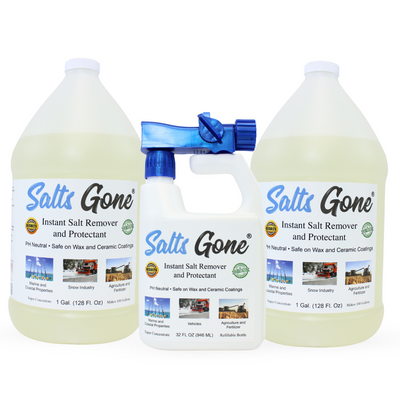
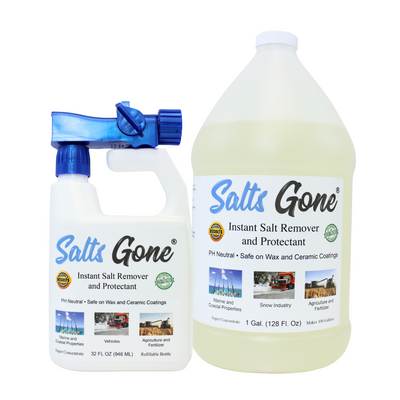
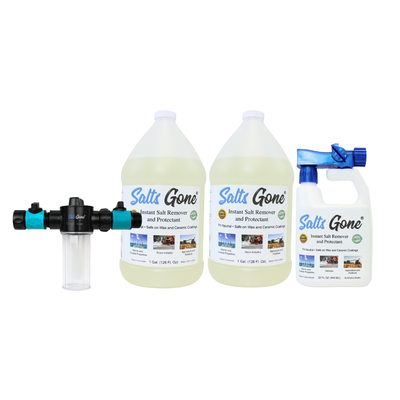
- Hose-end sprayer (32 oz): Attaches to any garden hose for automatic dilution. Ideal for vehicles, boats, and large equipment.
- Gallon concentrate: Mix at the recommended ratio for use in foam cannons, pressure washers, or spray bottles. Best value for frequent users and fleet operators.
- Ready-to-use spray bottle: Pre-mixed formula for spot treatment of small areas, interior components, and detailed work.
- 5-gallon pail: Bulk concentrate for commercial and industrial operations requiring high-volume application.
Rusts Gone is available in ready-to-use spray bottles for direct application to rusted surfaces.
Whether you are protecting a single vehicle or managing a fleet of hundreds, the Salts Gone® and Rusts Gone system provides comprehensive corrosion management that saves time, reduces maintenance costs, and extends the life of your most valuable assets.
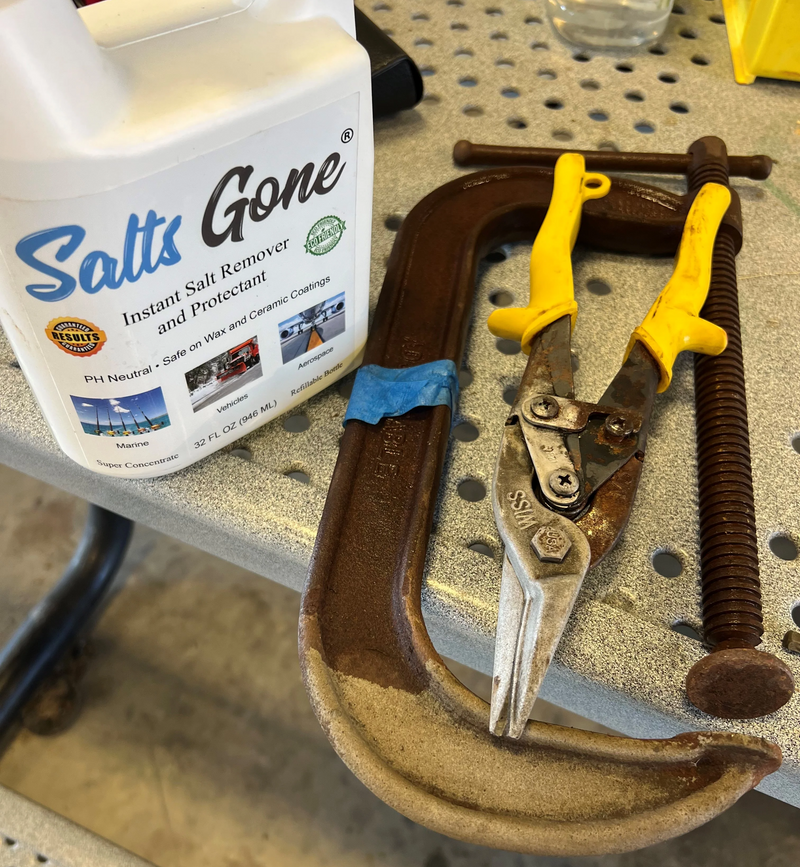
Watch How It Works
Start Protecting Your Investment Today
Combine Salts Gone® and Rusts Gone for complete corrosion management. Safe, effective, and trusted by professionals nationwide.
What Our Customers Say
Trusted by boaters, drivers, fleet operators, and homeowners across the country.
This is a must have if you live in the rust belt. I use it on my truck and tractor. It's amazing stuff.
As a coastal homeowner, we are finally able to efficiently protect our property from the corrosive environment around us.
I have been using Salts Gone on my boat and jet ski now for 2 years. Best product I have ever used. Way better than the competitors.
We use Salts Gone on our plow trucks after each snow event and are very happy with the results! Clean trucks with no salt residue left behind.
Best salt fighting product on the market. Honest advertisements unlike the competitor.
What a shocking experience! My pickup is not only showing no signs of salt, it is cleaner than it was before!
Featured Products
Salts Gone® & Rusts Gone FAQ
Everything you need to know about our two-product corrosion management system.