How-To Guides
How-To Guides

How to Use Salts Gone® - Step-by-Step Application Guides

From first application to advanced techniques — step-by-step guides that help you get the most out of every bottle.

Everything You Need to Know About Salt Removal
Expert Guidance

Everything You Need to Know About Salt Removal

Whether you're a first-time user or a seasoned pro, our how-to library covers every product, application method, and surface type. Browse guides below or use the filters to find exactly what you need.

Application Methods — Hose-end sprayer, foam cannon, pressure washer, hand spray — learn the right technique for every setup.
Surface-Specific Guides — Automotive, marine, aviation, concrete, metal — detailed instructions tailored to your exact use case.
Dilution & Mixing Ratios — Get the right concentration every time. Our guides cover ratios for light maintenance to heavy salt buildup.
Shop Now

Ready to Get Started?

Pick up the products you need and follow our guides for professional-grade results — every time.

How-To FAQ

Quick answers to the most common application questions.

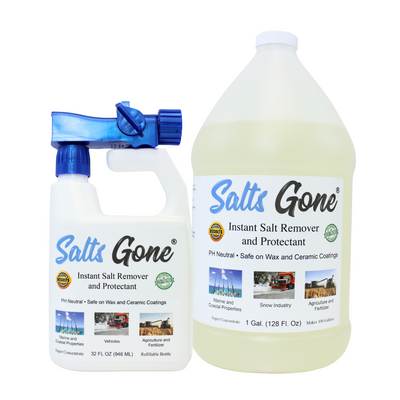
The standard ratio is 1:100 (1.28 oz per gallon of water) for most applications. For heavy salt buildup — like post-winter undercarriage treatment or marine use after ocean exposure — you can increase to 1:50 (2.56 oz per gallon). The hose-end sprayer automatically dilutes to the correct ratio.
Rinsing is recommended but not required. The chelation process happens on contact — once Salts Gone® has dwelled for 30–60 seconds (or longer on heavy deposits), the salt has been neutralized. Rinsing with clean water washes away the loosened compounds, but if rinsing isn't practical (like on electrical components or in tight spaces), you can simply let it air dry. No harmful residue is left behind either way.
Absolutely. Salts Gone® works great in a foam cannon. Fill the foam cannon reservoir with the gallon concentrate — the cannon's built-in metering will handle the dilution (note: this will not be a 1:100 ratio since foam cannons have their own draw rates). The foaming action increases dwell time on vertical surfaces like wheel wells, fenders, and trailer frames, giving the chelating agents more time to work. Check your foam cannon's manual for its specific dilution draw rate and adjust accordingly.
It depends on exposure. During winter or in coastal areas with daily salt contact, apply after every wash or at least weekly. For seasonal use (post-winter cleanup, after a beach trip), a single thorough application followed by a rinse is sufficient. Regular use prevents salt accumulation that leads to corrosion.
Salts Gone® removes salt and brine at a molecular level through chelation. Rusts Gone converts existing rust into a stable iron tannate surface that's ready for primer or topcoat — apply and let cure for 24 hours, no rinsing needed. Under Gone™ is a protective undercoating applied after Salts Gone® to create a long-lasting barrier against future salt exposure. They work as a system: remove salt → convert rust → protect.
Yes. Use a downstream chemical injector or a separate foam cannon attachment on your pressure washer. Apply the Salts Gone® solution at low pressure first, allow it to dwell, then switch to high pressure for the rinse. This is the most effective method for heavy equipment, fleet vehicles, and undercarriages.
Yes. Salts Gone® is pH-neutral, non-toxic, and biodegradable. It is safe for paint, clear coat, chrome, aluminum, stainless steel, rubber, plastic, vinyl, glass, gel coat, powder coat, electrical components, concrete, and more. It will not strip wax, ceramic coatings, or sealants.