

Quick Answer: Summer on the Gulf Coast means more trips, more saltwater exposure, and less time between rinses. When heat combines with heavy use and concentrated brine, corrosion accelerates faster than any other season. Boats getting regular use right now need a consistent salt removal routine, not just an occasional rinse.
July on the Gulf of Mexico is peak season. Boats that sat through a quiet spring are now running two, three, sometimes four trips a week. Bay boats are working Galveston's shallows. Center consoles are making the run to the Flower Gardens. Offshore rigs are seeing weekend traffic that rivals any other time of year. The water is warm, the fish are active, and the boats are getting hammered.
That hammering is not just miles and engine hours. Every trip offshore, every ramp launch, every afternoon on the bay deposits salt in places you cannot see. And this time of year, those deposits do not sit quietly waiting to be rinsed off. Summer heat accelerates the electrochemical reaction that turns salt exposure into corrosion. The Gulf is beautiful in July, but it is also doing more damage to your boat right now than at any other point in the year.
Why Summer Is the Hardest Season on a Saltwater Boat
Cold water slows chemical reactions. Hot water and hot ambient air speed them up. That is basic chemistry, and it applies directly to the corrosion process. When salt bonds to a metal surface, it creates an electrolytic cell, drawing moisture and enabling oxidation. At Gulf Coast summer temperatures, that reaction runs faster than it would in February.
Here is what is working against your boat right now:
- Water temperature: Gulf surface temperatures in July commonly reach 85 to 90 degrees Fahrenheit. Warmer water holds less dissolved oxygen, but it accelerates the electrochemical reactions that drive metal corrosion when salt is present.
- Air temperature and humidity: Coastal Texas summer air is hot and saturated with moisture. Salt that lands on a surface does not dry out and become inert. It pulls humidity from the air, stays wet, and keeps corroding. A boat sitting on a trailer in a Corpus Christi driveway at 95 degrees is still being corroded by residual salt between trips.
- UV exposure: Sun intensity peaks in summer. UV degrades gelcoat, paint, and protective coatings, which reduces the barrier between salt and the substrate underneath. Once a coating breaks down, salt reaches raw fiberglass or metal directly.
- Trip frequency: A boat used twice a week accumulates salt twice as fast as one used twice a month. More exposure means the window between trips where damage is accumulating is shorter and more frequent.
- Incomplete rinsing under pressure: When you are tired after a long day offshore and the dock is busy, the rinse gets cut short. In summer, with faster corrosion rates, a partial rinse leaves enough residual salt to do real damage before the next trip.
How Corrosion Actually Builds During Heavy-Use Season
Corrosion on a saltwater boat is not a single event. It is a process that compounds. Understanding the progression helps you see why timing your salt removal routine matters more in summer than any other time of year.
The first exposure deposits salt ions on every surface the boat contacts: hull, trailer, motor, trim tabs, outboard lower unit, bilge, electrical connections, transducer mount, rod holders, and livewells. Any surface that got splashed or submerged carries salt. Most of it is invisible once it dries.
On a warm summer day, residual moisture from that deposit evaporates quickly, but the sodium and chlorine ions stay behind. They are hygroscopic, meaning they pull moisture back out of the air. In Gulf Coast humidity, that happens almost immediately. The salt surface stays electrochemically active even when the boat looks dry.
Each subsequent trip adds another layer of salt before the previous layer has been properly removed. Over a busy summer of multiple weekly trips, that accumulation builds in crevices, under hatches, behind trim pieces, and inside rod holders where no rinse water reaches without focused application. By the time visible corrosion appears, the underlying process has been running for weeks.
For a deeper look at where offshore boats take the most damage and how it progresses, the SaltsGone guide on salt damage to offshore boats and marine equipment walks through the high-risk zones by component.
The Surfaces Taking the Most Damage Right Now
Not all surfaces corrode at the same rate or in the same way. During heavy summer use, these are the areas accumulating the most damage:
- Outboard lower units: Constantly submerged, exposed to prop wash, and made of aluminum. Salt works into every seam and fastener point. Heat accelerates the galvanic reaction between aluminum and stainless steel fasteners.
- Trailer bunks and frames: Every ramp launch and retrieval soaks the trailer completely. Steel frames with even minor coating damage are corroding between every trip. Galvanized trailers are not immune, particularly at weld points where the zinc coating is thinnest.
- Electrical connections: Bilge pump wiring, transducer connections, nav light grounds, and livewells all carry small electrical currents that accelerate corrosion dramatically when salt is present. This is called stray current corrosion and it operates faster in summer heat.
- Stainless hardware: T-tops, rod holder bases, grab rails, and cleats are typically stainless steel. Stainless resists corrosion through a passive oxide layer that requires oxygen to maintain. Salt-laden crevices around fasteners create low-oxygen environments that allow crevice corrosion to develop, appearing as rust staining around screw heads and fittings.
- Gelcoat above the waterline: Salt spray deposits on the hull sides, console, and hardtop dry in the sun and concentrate as water evaporates. Without removal, salt sits in surface pores and works into any micro-crack or oxidized area in the gelcoat.
What Rinsing with Water Actually Does (and Does Not Do)
This is the most common misconception in marine salt management: the belief that a thorough freshwater rinse removes the salt. It does not, not completely, and not permanently.
Freshwater dissolves salt, making it temporarily soluble. If you could rinse long enough and with enough volume to flush every surface, crevice, and enclosed space completely, you could move most of the salt. In practice, that does not happen. Water runs off flat surfaces and sits in low spots. It does not penetrate behind trim pieces, into wiring harness grommets, or into the threads of fasteners. Salt dissolved in rinse water re-deposits on surfaces as the water evaporates.
A rinse with water is better than nothing. But it is not salt removal. It is salt redistribution.
The difference with chelation-based removal is that the salt ions are captured and cannot re-bond. Once SaltsGone's formula contacts sodium and chlorine ions, it encapsulates them at a molecular level. When you rinse, the captured ions leave with the water rather than depositing back onto the surface as the water dries. For a full breakdown of the difference between rinsing and genuine removal across all marine and saltwater toy applications, see the SaltsGone marine salt removal guide.
Building a Summer Salt Routine That Keeps Up With Heavy Use
A salt removal routine during peak season has to match the pace of use. Here is what that looks like in practice for Gulf Coast boaters running consistent summer trips:
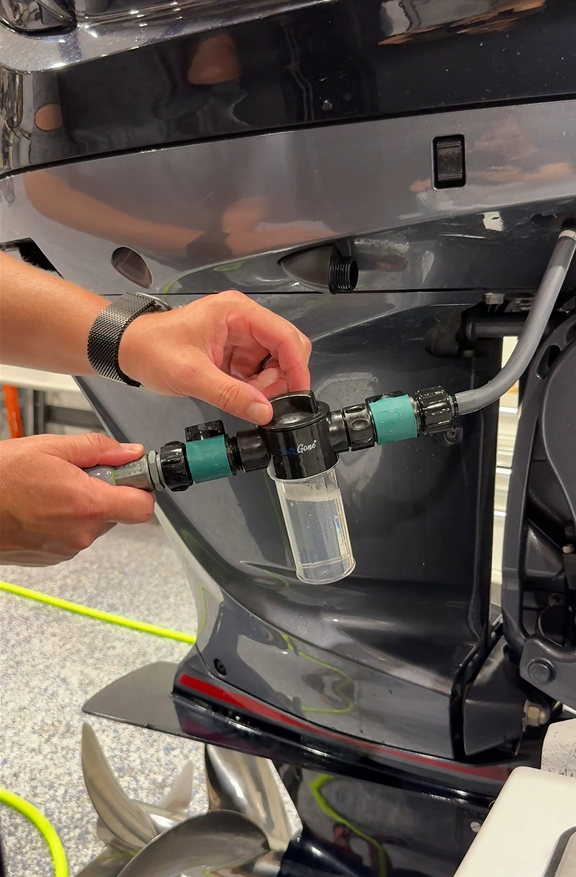
- After every offshore or bay trip: Apply SaltsGone to the hull, motor, lower unit, trailer, and all hardware before the salt dries. The Hose End Sprayer makes this a two-minute step at the ramp or at home.
- Focus on the trailer every launch: Trailer corrosion is often neglected because it is out of sight. Every ramp launch dunks the frame, axles, hubs, and wiring harness in salt water. Spraying the trailer before it dries is one of the highest-return habits a boater can build. The SaltsGone trailer care guide covers the most effective application approach for trailers specifically.
- Address the motor separately: Lower units and outboard housings need direct application, not just overspray from the hull rinse. Salt penetrates into cooling water intakes and exhaust ports during operation. Apply SaltsGone and let it work before rinsing.
- Do not skip weeks: A week of two to three trips without proper salt removal in July allows significant accumulation. The cost of skipping a routine is measured in accelerated corrosion on components that are expensive to replace.
- Post-storm cleanup is not optional: Gulf summer storms can push salt spray inland and deposit concentrated brine on boats stored in yards or on trailers. After any significant weather event, treat the boat as if it made an offshore trip. For more on storm-related salt damage, the SaltsGone storm cleanup guide covers what gets missed and what it costs when it does.
Summer Salt Damage vs. Off-Season Salt Damage: What's Different
| Factor | Summer (Peak Use Season) | Off-Season / Winter |
|---|---|---|
| Trip frequency | Multiple per week | Occasional to none |
| Corrosion rate | Accelerated by heat and humidity | Slower; reduced temperature |
| Salt accumulation pace | Rapid, compounding between trips | Slow or static |
| UV damage to coatings | High; protective barrier degrades faster | Low; coatings hold longer |
| Ambient humidity (Gulf Coast) | High; salt stays wet longer | Moderate; salt dries more between trips |
| Rinsing consistency | Often rushed; end-of-day fatigue | More deliberate; winterization routine |
| Risk window | 24 to 48 hours between trips | Weeks; lower urgency |
Texas Boating Season and Salt Exposure: What the Numbers Mean
Texas Parks and Wildlife reports that Gulf Coast boat ramps, particularly those at Galveston, Port Aransas, Rockport, and South Padre Island, see peak traffic from Memorial Day through Labor Day, with July being the single busiest month. More boats on the water means more boats being damaged by salt, and more boats where the damage is being ignored or underestimated.
The Gulf of Mexico has an average salinity of around 36 parts per thousand, slightly higher than the global ocean average due to high evaporation rates in the warm, semi-enclosed Gulf basin. That concentration does not vary by season, but the rate at which it damages surfaces does. July water temperatures near the Texas coast regularly exceed 85 degrees, and heat accelerates electrochemical corrosion rates in proportion to temperature increase.
Texas also has no mandatory salt removal standard for recreational vessels, but the Texas Department of Motor Vehicles and Texas Parks and Wildlife both recommend freshwater rinsing after saltwater use as a baseline for vessel preservation. That baseline, as covered above, is the floor, not the ceiling. Peak season demands a higher standard.
The SaltsGone Approach to Summer Salt Defense
SaltsGone was developed for exactly this kind of environment. The Gulf Coast is part of the company's origin story. Built in Pearland, Texas, with Gulf Coast corrosion conditions as the primary design environment, the formula reflects what actually happens to boats running the Texas coast all summer.
Engineered for high-frequency use. At a 1:100 dilution ratio, one gallon of SaltsGone concentrate makes 100 gallons of working solution. Running two or three trips a week through a busy July does not require a new bottle every week. The concentrate is built for the volume that peak season demands without the cost that would come with a ready-to-use product at the same application rate.
Chelation chemistry that keeps up with heat. The chelation mechanism in SaltsGone is not affected by ambient temperature in a way that reduces its performance. It bonds to salt ions in hot conditions as effectively as in cool ones. The corrosion process accelerates in summer heat, but so does the speed at which SaltsGone captures and removes the salt causing it.
Safe on every surface that summer use puts at risk. Gelcoat, aluminum lower units, stainless hardware, rubber seals, painted surfaces, chrome, and vinyl upholstery can all be treated with the same product in the same routine. There is no need to manage separate products for different surfaces or worry about compatibility. Visit the SaltsGone marine page for the full surface coverage breakdown.
Proven on the Gulf Coast by Gulf Coast boaters. The 1,100+ five-star reviews that SaltsGone has collected include captains, guides, and weekend warriors running Texas coastal waters. The product has been tested in the conditions it was built for, by the people it was built for. Read what they have to say at saltsgone.com/pages/streamline-customer-reviews.
The Gulf is heating up. Your boat is getting more use than at any point in the year. The conditions for accelerated corrosion are as good as they get right now. The routine that protects your investment starts with understanding what is actually happening to your hull, your motor, and your trailer between trips, and doing something more effective than a garden hose rinse about it. Explore the full SaltsGone product line at saltsgone.com and build a summer routine that keeps up with the season.
Frequently Asked Questions
Does salt actually corrode faster in summer heat on the Gulf Coast?
Yes. Electrochemical corrosion rates increase with temperature. The same salt deposit that would cause minimal damage at 60 degrees creates measurably more corrosion at 90 degrees over the same time period. Combined with Gulf Coast humidity, which keeps salt deposits wet and electrochemically active, summer is genuinely the highest-risk season for salt corrosion on marine vessels.
How soon after a saltwater trip should I apply SaltsGone?
As soon as possible, ideally before the boat leaves the ramp. Salt damage begins immediately on contact and accelerates as surfaces heat up in the sun. Applying SaltsGone while the boat is still wet from the trip and before surfaces have had time to heat up in the summer sun is the most effective timing. Waiting until you get home is better than not treating at all, but the sooner the better.
My boat sits on a trailer in my driveway between trips. Is salt still damaging it when it is out of the water?
Yes. Residual salt on the hull, trailer, and motor stays electrochemically active as long as humidity is present, and Gulf Coast summer humidity is rarely low enough to fully deactivate salt deposits. A boat sitting on a trailer in Houston or Corpus Christi in July is being corroded between every trip by the salt left from the last one. This is why post-trip treatment rather than pre-trip rinsing is the correct approach.
Is SaltsGone safe to use on a boat that has a fresh wax or ceramic coating applied this season?
Yes. SaltsGone is pH-neutral and relies on chelation chemistry rather than chemical reactivity. It removes salt ions without stripping wax, degrading ceramic coatings, or affecting any other protective surface treatment. You can apply it as part of every post-trip routine without concern for your detailing investment.


