

Salts Gone® vs Salt Terminator — Side-by-Side Review
Two salt removal products. Two very different approaches. See how patented chelation technology compares to traditional surfactant-based flushing — and why more professionals are making the switch.
Salts Gone® vs Salt Terminator
A detailed feature-by-feature comparison of two leading salt removal products.
Salts Gone® vs Salt Terminator: The Full Breakdown
Salt Terminator vs Salts Gone: Legacy vs Innovation
Salt Terminator has been on the market for years and has built a loyal following in the marine space. It became a go-to product for boat owners looking to flush salt from outboard engines and raw-water cooling systems after a day on the water. That reputation was built on years of availability in the marine market and strong word-of-mouth among boat owners.
But the chemistry behind Salt Terminator hasn’t evolved. It still relies on a surfactant-based approach that loosens and flushes salt from surfaces. While this was an improvement over plain water, the science of salt removal has moved forward significantly. Salts Gone® represents the next generation of salt removal, built on chelation chemistry — the same molecular science used in water treatment, medical detoxification, and industrial metal processing. Instead of simply washing salt away, Salts Gone® captures and neutralizes salt ions at the molecular level, delivering a fundamentally deeper clean.
Why ‘Flushing’ Isn’t the Same as ‘Removing’
Salt Terminator is designed to flush salt from engines, cooling systems, and exterior surfaces. Flushing works by diluting salt with a cleaning solution and rinsing it out of the system. The problem is that dilution is not elimination. When you flush with a surfactant, you reduce the concentration of salt in the system, but you don’t capture the individual ions responsible for corrosion. Residual sodium, calcium, and magnesium ions can remain bonded to metal surfaces inside engine passages, heat exchangers, and micro-pores in painted or anodized finishes.
Chelation works differently. Salts Gone®'s proprietary chelating agents form coordinate covalent bonds with calcium (Ca²⁺) and magnesium (Mg²⁺) ions on contact. Each chelating molecule wraps around the target ion and locks it into a stable, water-soluble complex. Once chelated, the ion cannot redeposit on the surface or recrystallize when the water evaporates. This is permanent removal — not temporary displacement. For anyone dealing with calcium chloride road brine or magnesium-heavy marine salt, this distinction matters enormously.
Beyond Marine: The Multi-Industry Advantage
Salt Terminator was designed primarily for the marine market — boat engines, outdrives, and trailer components. It does that job adequately, but its application range stops there. Salts Gone® was engineered from the ground up as a universal salt removal solution that works across every industry where salt causes damage.
Today, Salts Gone® is used in automotive care for road salt and brine removal, in aviation where the Salts Gone® Aviation Formula is referenced in Cessna aircraft maintenance manuals, in commercial fleet operations spanning thousands of vehicles, in agriculture for equipment exposed to fertilizer salts and irrigation minerals, in industrial settings for heavy machinery and infrastructure, and in coastal property maintenance for homes, outdoor furniture, and building facades. That cross-industry versatility is possible because chelation chemistry is surface-agnostic — it targets the salt ions themselves, regardless of the substrate they’ve bonded to.
The Protective Film That Salt Terminator Doesn’t Leave
One of the most significant differences between the two products is what happens after the wash. Salt Terminator rinses clean. Once the product is flushed from the system, there is no residual protection on the treated surfaces. The metal, paint, or gel coat is immediately re-exposed to the environment, and the next salt exposure starts the corrosion cycle over from scratch.
Salts Gone® takes a different approach. After the chelation process removes salt ions from the surface, the formula deposits a thin, corrosion-inhibiting film on the treated substrate. This protective barrier reduces the rate of future salt adhesion and slows oxidation between treatments. It is not a permanent coating — it’s a sacrificial layer that buys you meaningful time between washes, especially in harsh environments where salt exposure is constant. For boat owners who can’t flush after every trip or fleet managers who need to extend service intervals, that residual protection is a critical advantage.
Dilution & Value Comparison
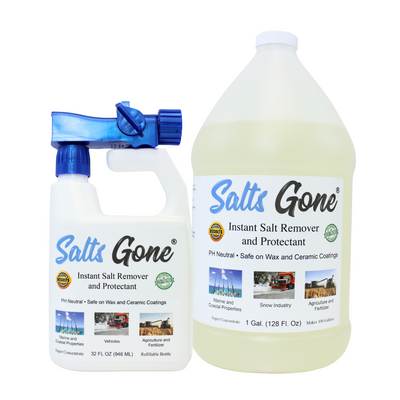
Salts Gone® concentrate mixes at a consistent 1:100 ratio with water across all application methods — hose-end sprayer, foam cannon, pressure washer downstream injector, or manual spray bottle. One gallon of concentrate produces 100 gallons of ready-to-use solution, making the cost per wash extremely low. Salt Terminator’s dilution ratios vary depending on the specific product and application method, which can make it harder to calculate true cost per treatment. When you factor in Salts Gone’s® deeper ion-level cleaning, residual protective barrier, and multi-surface versatility, the per-wash value comparison favors Salts Gone® — especially for users who treat vehicles, boats, or equipment regularly throughout the season.

Upgrade to Next-Generation Salt Removal
Experience the difference chelation chemistry makes. Deeper cleaning, lasting protection, and proven performance across every industry.
What Our Customers Say
Trusted by boaters, drivers, fleet operators, and homeowners across the country.
This is a must have if you live in the rust belt. I use it on my truck and tractor. It's amazing stuff.
As a coastal homeowner, we are finally able to efficiently protect our property from the corrosive environment around us.
I have been using Salts Gone on my boat and jet ski now for 2 years. Best product I have ever used. Way better than the competitors.
We use Salts Gone on our plow trucks after each snow event and are very happy with the results! Clean trucks with no salt residue left behind.
Best salt fighting product on the market. Honest advertisements unlike the competitor.
What a shocking experience! My pickup is not only showing no signs of salt, it is cleaner than it was before!

Common Questions About Salts Gone® vs Salt Terminator
Everything you need to know before choosing a salt removal product.