

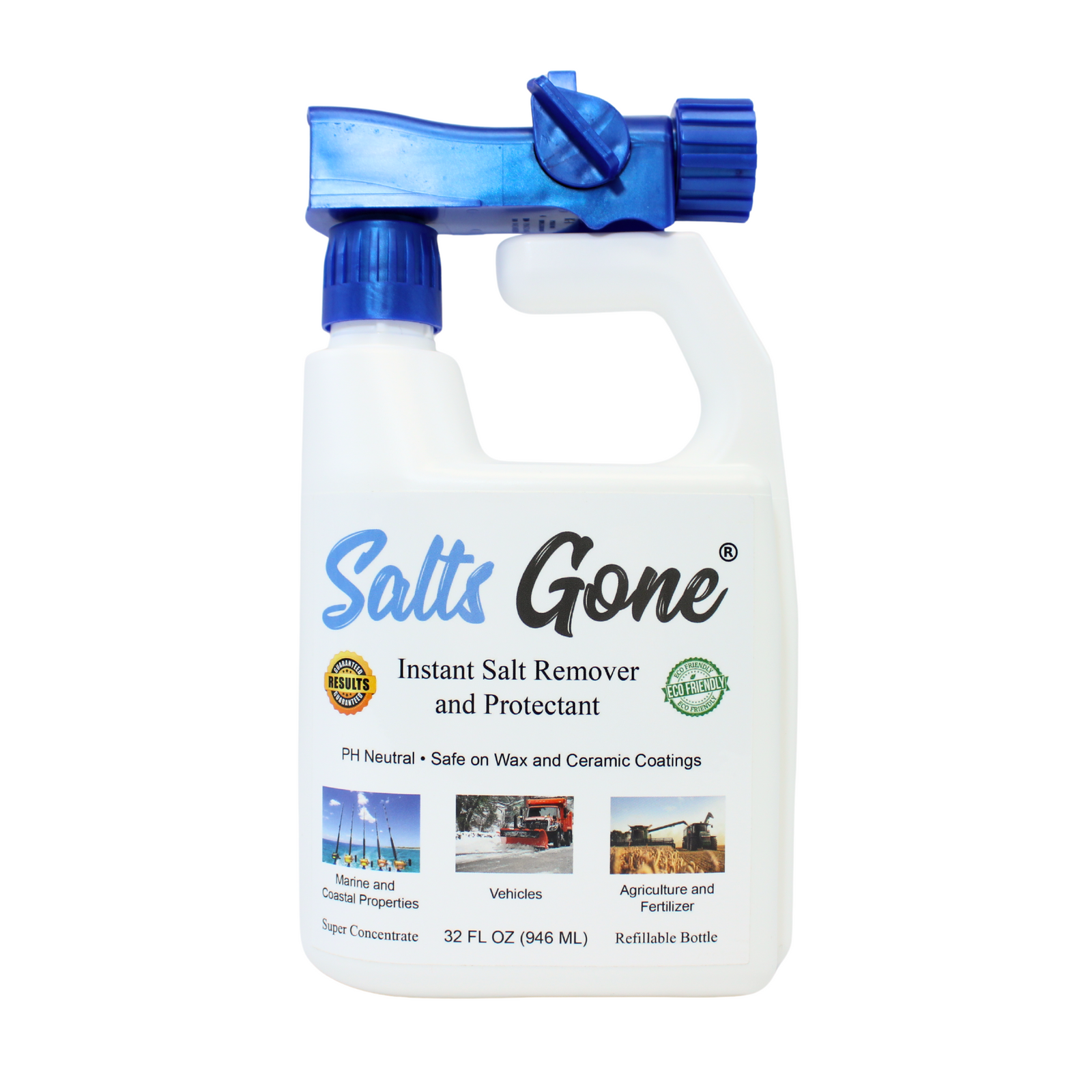
Are ALL Salt Removers pH-Neutral?
Quick Answer: SaltsGone is pH-neutral because its chelation-based formula breaks salt bonds at a molecular level without relying on acids or alkalis. Most salt removers are not pH-neutral. Many use acidic or caustic chemistry that strips protective coatings, corrodes metals, and degrades rubber seals over time.
If you own a saltwater boat on the Gulf Coast, run a truck through Texas road brine every winter, or manage a fleet that sees both, the label on your salt remover matters more than most people realize. "Salt remover" is a broad category. What goes into the bottle varies widely, and pH is one of the most consequential variables in that formula.
This article explains what pH-neutral actually means in chemistry, why SaltsGone is formulated that way, and what happens to your hull, paint, aluminum, or chrome when you apply a product that is not.
What pH-Neutral Actually Means
pH measures how acidic or alkaline a solution is on a scale of 0 to 14. A pH of 7 is neutral, pure water being the benchmark. Anything below 7 is acidic. Anything above 7 is alkaline, or basic.
- Acidic solutions (pH below 7): vinegar, muriatic acid, many descalers and rust removers
- Neutral solutions (pH near 7): pure water, SaltsGone
- Alkaline solutions (pH above 7): bleach, many degreasers, some industrial wash products
pH-neutral does not mean weak or ineffective. It means the solution neither donates hydrogen ions (acids do this) nor accepts them (bases do this). For a salt remover, that distinction is critical. The mechanism doing the work is chemistry, not corrosive reactivity.
How the Process Works: Chelation Without Chemical Aggression
Salt is sodium chloride, a compound composed of sodium (Na) and chloride (Cl) ions. When salt dries on a surface, it does not simply sit there. It pulls moisture from the air, creates an electrolytic environment, and accelerates oxidation wherever metal is exposed. On a boat trailer left after a weekend on Galveston Bay, that process begins within hours.
Most rinse products and generic salt removers use water plus a surfactant or a mild acid to dissolve salt. Water-based rinsing works temporarily. The moment the rinse water evaporates, remaining salt ions can re-bond and continue their work. Acidic products dissolve salt more aggressively but introduce a new problem: the acid does not discriminate. It reacts with the salt and with the surface underneath.
SaltsGone uses chelation technology. The chelating agents in the formula bond directly to the sodium and chlorine ions, encapsulating them and preventing them from reattaching to any surface. The salt is not dissolved; it is left behind in a weaker form. It is physically captured at a molecular level and flushed away when you rinse. No acid required. No alkaline accelerant needed.
This is the same class of chemistry used in food processing and industrial salt mining applications, where aggressive pH would destroy equipment. SaltsGone brought that industrial-grade formulation to the marine and automotive market. You can read more about how SaltsGone's chelation process works on their science page.
Are All Salt Removers pH-Neutral?
No. Most are not, and the marketing language on their labels often obscures this fact.
Many products described as "boat wash," "marine rinse," or "salt away" rely on surfactant-heavy formulas that are mildly acidic or mildly alkaline. The pH may be only slightly off from neutral, but repeated application compounds the effect. A product at pH 5 applied weekly to an aluminum lower unit will cause measurable surface degradation over a single season. A product at pH 9, when applied to a gelcoat hull, will gradually dull the finish and attack sealants.
Some products intentionally lean into acidity because it makes them feel effective. Acidic cleaners cut through mineral deposits visibly and quickly. That immediate result reads well in the first few uses. The cost shows up later, in chalking paint, degraded seals, etched chrome, and anodized aluminum that no longer holds its surface treatment.
The honest answer is that the salt removal market has no standardized pH requirement. A product can legally be marketed as a salt remover regardless of its pH. That puts the burden on the buyer to know what to look for, and most buyers do not check the Safety Data Sheet before pouring a product on a $60,000 center console.
What Non-Neutral pH Does to Boats and Vehicles
The damage from pH-aggressive salt removers is cumulative and often invisible until it reaches a threshold. Here is what to watch for and what causes it:
- Gelcoat oxidation: Alkaline cleaners strip the surface wax and, with repeated use, attack the gelcoat binder. The hull loses its shine and begins to chalk.
- Aluminum pitting: Both acid and strong alkalis attack aluminum. On outboard lower units, trim tabs, and aluminum trailers, pitting appears as small white or gray pockmarks that weaken the structure over time.
- Rubber seal degradation: Hatch seals, weatherstripping, and prop shaft seals are vulnerable to pH extremes. Cracking and swelling accelerate when an off-neutral product contacts rubber repeatedly.
- Chrome and stainless etching: The passive oxide layer that gives stainless steel its corrosion resistance can be disrupted by acidic products. Once that layer is compromised, rust begins.
- Wax and ceramic coating loss: Alkaline degreasers strip wax rapidly. A ceramic coating has better chemical resistance but is not impervious to highly alkaline wash products used repeatedly.
- Paint dullness: On trucks and trailers, slightly acidic or alkaline products used through a rust-belt winter will visibly dull paint within one to two seasons.
None of these outcomes require a dramatically off-pH product. A consistent pH of 5 or 9, applied weekly, is enough to produce visible damage within a single boating season.
pH-Neutral vs. Acidic Salt Removers: A Direct Comparison
| Feature | pH-Neutral (SaltsGone) | Acidic or Alkaline Salt Remover |
|---|---|---|
| Salt removal mechanism | Chelation, molecular bond-breaking | Chemical dissolution via pH reaction |
| Safe on gelcoat | Yes | Risk with repeated use |
| Safe on aluminum | Yes | Risk of pitting over time |
| Safe on rubber seals | Yes | Degradation risk |
| Wax / ceramic coating safe | Yes | May strip wax; variable on ceramic |
| Salt reattachment prevention | Yes, ions are captured | No, dissolved ions can re-bond |
| Biodegradable | Yes | Varies; many are not |
| Safe around marina environments | Yes | Check SDS; many carry environmental cautions |
Texas Regulations and pH-Related Considerations
Texas does not have a statewide product-specific regulation governing the pH of boat wash products used at private docks or on trailered vessels. However, several relevant frameworks apply to how and where you use cleaning products on the water.
- The Texas Commission on Environmental Quality (TCEQ) regulates discharge of pollutants into state waters. Cleaning a boat in a marina, on a boat ramp, or near a waterway with a product that contains non-biodegradable surfactants or pH-aggressive chemistry can constitute a discharge violation depending on concentration and proximity to the water.
- The Clean Vessel Act, administered federally but enforced through Texas Parks and Wildlife, applies specifically to waste discharge from vessels but also reflects the broader regulatory intent to protect Texas coastal waters, including the bays and estuaries around Galveston, Corpus Christi, and Port Aransas.
- Many Gulf Coast marinas have posted guidelines or lease agreements that restrict the use of chemical wash products on their property. A pH-neutral, biodegradable product like SaltsGone avoids compliance issues at nearly every marina from Rockport to South Padre Island.
- Commercial fleet operators in Texas using salt management products on municipal or state-contracted vehicles may be subject to environmental compliance documentation requirements. pH-neutral, non-hazardous products simplify that compliance record.
The practical takeaway: using a non-neutral product does not automatically mean you are breaking a law. But using a pH-neutral, biodegradable product means you are not at risk of breaking one, regardless of where on the Texas coast you are cleaning your boat or truck.
When to Use a pH-Neutral Salt Remover and When Not To
pH-neutral chelation chemistry is the right tool when your goal is regular, preventive salt removal. Use it after every offshore trip, after driving through road brine, after a storm surge hits your dock, or as part of a weekly maintenance routine on a coastal property.
There are situations where a pH-neutral product is not the first tool to reach for:
- Heavy mineral scale deposits: Calcium and magnesium scale from hard water or marine growth may require a targeted descaler, which by nature is mildly acidic. After descaling, follow up with SaltsGone to remove remaining salt and protect the surface.
- Active rust conversion: If rust has already formed, a rust converter like Rusts Gone addresses existing oxidation. pH-neutral salt removers prevent the conditions that create rust; they are not rust treatment products.
- Heavy industrial contamination: Some industrial environments involve contamination beyond salt. Those situations may require targeted chemistry before a preventive salt removal protocol is established.
For the overwhelming majority of marine and automotive applications, including every boat that splashes on the Gulf Coast and every truck that sees Texas road treatment, pH-neutral chelation chemistry is the correct routine product.
Built Different: Why SaltsGone's Formula Outperforms on Every Surface
SaltsGone is not a reformulated household cleaner or a diluted version of a marine wash product. The formula originated in food processing and salt mining industrial environments, where pH stability was non-negotiable and surface safety was a hard requirement. That heritage shows up in results.
Decade-proven industrial chemistry, consumer-ready delivery. The chelation technology in SaltsGone was developed and validated in environments where a pH-aggressive product would have destroyed equipment worth millions. The science did not change when the product was made available to boaters and truck owners. The same molecular mechanism that protected industrial machinery now protects your hull, your undercarriage, and your outboard.
True surface universality. SaltsGone is safe on gelcoat, fiberglass, aluminum, chrome, stainless steel, painted surfaces, rubber, and vinyl. That is not a marketing claim. It is the direct result of pH-neutral chemistry. There is no surface type that requires you to test a corner first or dilute further before applying. Visit the SaltsGone marine application page to see the full range of surfaces covered.
Corrosion inhibition built in. Removing salt is one step. SaltsGone goes further by leaving behind a corrosion-inhibiting barrier after the rinse. Competing products that rely on pH reactivity for salt removal do not have the chemistry available to leave behind a protective layer. They spend their active ingredient fighting pH reactions rather than building protection.
1,100+ five-star reviews from real users across real conditions. Gulf Coast boaters running offshore in the Gulf of Mexico, fleet operators in rust-belt states, agricultural equipment operators in Texas, and coastal homeowners from Galveston to South Padre have verified the results. Check the SaltsGone customer reviews to read accounts from users in conditions identical to yours.
Made in Pearland, Texas. SaltsGone is manufactured in the Gulf Coast region it was built to serve. That matters because the formula was developed with an understanding of the specific salt environments Texas boaters and drivers deal with, including high-humidity coastal salt air, road brine from ice management in North Texas, and the concentrated saltwater exposure that comes with fishing the Gulf every weekend.
Explore the full product line at saltsgone.com, including the Hose End Sprayer for marine use and gallon options for fleet and commercial applications.
Frequently Asked Questions
Does pH-neutral mean SaltsGone is less effective than stronger chemical cleaners?
No. Effectiveness in salt removal is determined by the mechanism, not the pH. Chelation is a more targeted and thorough mechanism than acid dissolution because it captures salt ions at a molecular level and prevents reattachment. A product can be highly effective and pH-neutral simultaneously. The two are not in conflict.
How do I know if a salt remover I am already using is pH-neutral?
Check the product's Safety Data Sheet (SDS), which manufacturers are required to provide. The SDS will list pH along with other chemical properties. If the product does not have an SDS available, that itself is a warning sign. You can also use a basic pH test strip on a diluted sample of the product. SaltsGone's SDS is available directly at saltsgone.com/pages/streamline-safety-data-sheets.
Can I use SaltsGone on a boat with a ceramic coating or fresh wax?
Yes. Because SaltsGone is pH-neutral and relies on chelation rather than chemical reactivity, it does not strip wax or degrade ceramic coatings. It removes soluble chlorides (salt) while leaving your protective coatings fully intact. This is one of the most practical advantages for boaters who invest in detailing or ceramic protection.
Why do some salt removers not disclose their pH on the label?
Labeling regulations do not require pH disclosure on consumer product labels. Manufacturers are only required to disclose certain hazard classifications. A mildly acidic or alkaline product may not meet the threshold for a hazard label even though its pH causes cumulative surface damage over time. Reading the SDS is the most reliable way to know what you are actually applying to your boat or truck.
Is there a situation where I would want an acidic salt remover instead of a pH-neutral one?
Acidic products are sometimes used for heavy mineral scale removal, specifically calcium or magnesium deposits from hard water, not salt removal per se. For actual sodium chloride removal from marine and automotive surfaces, there is no application where an acidic product outperforms a pH-neutral chelation product. The acid creates additional surface risk without a corresponding benefit in salt removal performance.


