

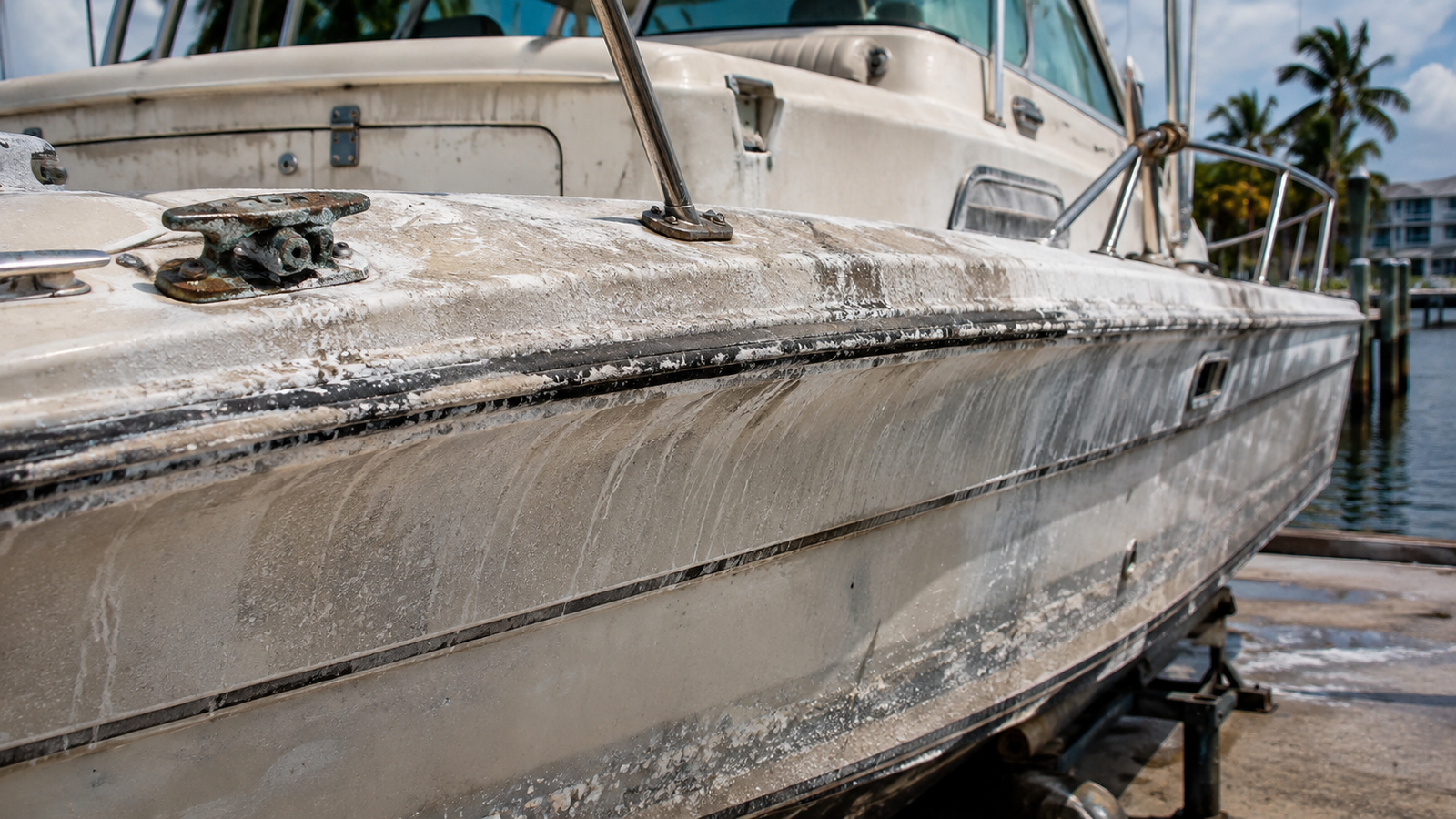
Quick Answer: Skipping salt removal through a full Gulf Coast summer causes compounding corrosion across every metal, electrical, and mechanical component on your boat. What starts as surface deposits in June becomes pitted aluminum, failed electrical connections, seized hardware, and degraded gelcoat by September. The damage is cumulative and largely invisible until it becomes expensive.
Nobody skips salt removal on purpose. It happens in degrees. A tired evening after a long offshore run. A ramp line that is too long to wait through. A quick rinse that felt like enough. Multiply that across a busy Gulf Coast summer of two or three trips a week, and by the time September arrives, a boat that looked fine in May is showing the accumulated cost of four months of incomplete salt management.
This article walks through exactly what happens, component by component, when salt is allowed to build up through peak season. The timeline is real, the damage is predictable, and most of it is preventable with a consistent routine.
How Salt Damage Compounds Over a Summer Season
The key thing to understand about salt corrosion is that it doesn't reset between trips. Each outing adds a new layer of salt on top of whatever remained from the last one. Corrosion that starts at a microscopic level in June can become surface-visible by August if nothing interrupts it.
Gulf Coast conditions amplify this process. Summer water temperatures regularly exceed 85 degrees Fahrenheit. Ambient humidity on the Texas coast stays high enough that salt deposits never fully dry out between trips, keeping the electrolytic environment active. UV exposure degrades the protective coatings that would otherwise slow salt penetration. All three factors run simultaneously through July and August, the two highest-use months of the boating year.
The compounding effect means the damage done in week eight of no treatment is not the same as the damage done in week one. It is significantly worse, because each prior week's damage has created new entry points for salt, expanded existing corrosion sites, and weakened protective layers that would have slowed the process in an earlier week.
Week by Week: What Salt Is Doing to Your Boat Right Now
Weeks 1 to 2: Surface Deposits Form
Salt is invisible when dry on most surfaces. In the first week or two after you skip treatment, sodium and chloride ions deposit on hull sides, hardware, motor housings, and trailer frames. There is nothing to see yet. The gelcoat looks fine. The stainless is shiny. The motor looks the same as it did at the start of the season.
Under the visible surface, salt pulls moisture from Gulf Coast air and begins the electrochemical process that drives corrosion. At weld points on the trailer, at fastener threads on stainless hardware, and at any point where two dissimilar metals contact each other, the process is already running.
Weeks 3 to 4: Penetration Into Crevices and Joints
Salt dissolved in spray and rinse water finds its way into every crevice through capillary action. By week three or four without treatment, salt has migrated into the threads of every fastener that got wet, behind trim rings and escutcheons, into the seams of hatches and rod holders, and into wiring harness grommets. These enclosed spaces have limited oxygen, which creates the low-oxygen environment where crevice corrosion accelerates.
On the trailer, paint that was protecting frame steel has been repeatedly stressed by ramp launches, and any chip or scratch is now an active corrosion site with three weeks of accumulated salt working into it.
Weeks 5 to 8: Visible Corrosion Begins
By the midpoint of summer, the first visible signs appear. Rust staining around stainless fasteners and hardware. White or gray pitting beginning on aluminum surfaces, particularly on the lower unit and trim tabs. Chalking or dullness on gelcoat in areas that see the most sun and spray. Trailer frame showing surface rust at welds and any point where the coating was compromised.
Electrical connections are also beginning to fail by this point. Bilge pump terminals, nav light grounds, and transducer connections coated in unremoved salt are developing resistance that shows up as intermittent failures. A bilge pump that worked perfectly in May starts running slow or not at all by August.
Weeks 9 to 12: Structural and Mechanical Consequences
By late summer, a boat that received no salt treatment is dealing with damage that goes beyond cosmetics. Fasteners that have corroded in their threads may seize or shear when removal is attempted. Trailer wheel bearings packed with grease that has been contaminated by salt water are failing or near failure. Aluminum lower unit anodes have been depleted faster than expected because they have been fighting accelerated galvanic corrosion all season.
Wiring failures that started as intermittent issues are now consistent. Hatch seals and rubber gaskets that have been in contact with salt and UV all summer are cracking and no longer sealing correctly. The gelcoat that was losing its wax protection in week four has now oxidized visibly in high-exposure areas.
The Surfaces That Pay the Highest Price
Not every surface corrodes at the same rate. These are the components where a skipped summer salt routine does the most damage:
- Outboard lower unit: Aluminum in constant contact with saltwater, subjected to prop wash, and housing moving parts. A summer without treatment accelerates galvanic corrosion between the aluminum housing and stainless steel components, and salt works into every water intake port and exhaust opening.
- Trailer frame and axles: Dunked in salt water at every launch and retrieval. Without treatment, bare steel at any paint chip or weld gap corrodes through the summer at a rate that can compromise structural integrity by the following season.
- Electrical system: Marine electrical systems are already operating in a corrosion-prone environment. Untreated salt deposits on terminals and grounds create resistance that degrades system performance and eventually causes failures in components that are labor-intensive and expensive to repair.
- Stainless steel hardware: The passive oxide layer that protects stainless breaks down in low-oxygen crevice environments. T-top frames, rod holders, grab rails, and cleats all develop rust staining and eventually pitting when salt is not regularly removed.
- Gelcoat and hull surfaces: UV plus salt is an accelerated degradation combination. Gelcoat that loses its wax protection early in summer due to salt accumulation is exposed to four months of peak UV without adequate protection. Oxidation and chalking are the visible result.
For a full breakdown of which components on an offshore boat are most vulnerable and where damage tends to start, the SaltsGone guide on salt damage to offshore boats and marine equipment covers each zone in detail.
What a Rinse With Water Actually Prevents (and What It Does Not)
Many boaters who skip a full salt removal routine still rinse with fresh water at the ramp or at home. That is better than nothing, but it is important to understand what a water rinse actually accomplishes.
Fresh water dissolves salt temporarily, making it soluble. If applied with enough volume and pressure to every surface, it moves some salt. What it does not do is capture salt ions and prevent them from re-depositing. As rinse water evaporates, dissolved salt re-concentrates on whatever surface it evaporated from. Salt that was rinsed into a crevice and dissolved there re-deposits in that crevice as the water dries.
A water rinse also does not penetrate the places where salt accumulates most aggressively: inside fastener threads, behind trim pieces, into wiring harness grommets, under hatch seals. Those locations retain salt regardless of how thorough the topside rinse was.
Chelation-based removal captures salt ions before they can re-deposit. The sodium and chloride are encapsulated at a molecular level and leave with the rinse water rather than staying behind. That is the operational difference between rinsing and actually removing salt. For more on how this plays out across all marine applications, the SaltsGone marine salt removal guide covers the distinction in depth.
The Real Cost of a Skipped Summer Routine
Corrosion damage done over a summer without salt treatment does not reverse itself when fall arrives. Here is what the repair side of a skipped summer looks like:
- Lower unit rebuild or replacement: $500 to $2,500 depending on motor size and damage extent
- Trailer frame repair or replacement: $800 to $3,000 for significant structural corrosion
- Marine electrical system diagnosis and rewiring: $150 to $500 per connection point, more for full harness replacement
- Gelcoat compounding, polishing, and resealing after oxidation: $300 to $1,500 for a production boat; more for larger vessels
- Stainless hardware replacement: $50 to $400 per fitting, multiplied across a full complement of deck hardware
- Wheel bearing service or replacement: $150 to $400 per axle
A consistent SaltsGone routine through peak season costs a fraction of any single item on that list. At a 1:100 dilution ratio, one gallon of concentrate treats 100 gallons of working solution, meaning the cost per application for a typical boat is measured in dollars, not hundreds of dollars. The math is not complicated.
Texas Boating Season and the Window That Matters
Texas Parks and Wildlife data consistently shows July and August as the peak months for Gulf Coast recreational boating activity. Galveston, Port Aransas, Rockport, and South Padre Island ramps see their highest traffic during this window. More trips mean more salt exposure, and summer heat means faster corrosion rates on every deposit that is not removed.
Texas also has no regulatory requirement for salt treatment on recreational vessels, which means the decision is entirely left to the boat owner. That absence of external accountability is precisely why so many boats on Gulf Coast trailers arrive at fall storage carrying a summer's worth of damage that was entirely preventable.
The window that matters most is the one between trips. A boat that sits on a trailer in a Galveston driveway for four days between outings in July is being corroded by the salt from the previous trip for every one of those four days. Gulf Coast humidity keeps salt deposits electrochemically active. The protective routine belongs at the end of the trip, not at the beginning of the next one.
Why SaltsGone Is the Right Tool for a Consistent Summer Routine
Built for the volume that peak season demands. Multiple trips per week requires a product that is economical enough to use every time without a second thought. At a 1:100 concentrate ratio, SaltsGone is designed for exactly that frequency. One gallon handles the entire summer for most recreational boaters. Explore the full concentrate line at saltsgone.com/collections/salts-gone.
One product, every surface. The reason post-trip treatment gets skipped is often friction. Multiple products for different surfaces, different dilutions, different compatibility concerns. SaltsGone is pH-neutral and safe on gelcoat, aluminum, stainless, rubber, vinyl, chrome, and painted surfaces. One product handles the hull, the motor, the trailer, and the hardware in a single routine pass.
Corrosion inhibition that stays behind. After the rinse, SaltsGone leaves a corrosion-inhibiting barrier on treated surfaces. That protective layer provides coverage between the current trip and the next application, adding a secondary layer of defense beyond the immediate salt removal. Learn more about how the formula works at saltsgone.com/pages/how-it-works.
Proven on Gulf Coast boats by Gulf Coast boaters. The 1,100+ five-star reviews on SaltsGone include captains, guides, and weekend anglers running the exact conditions this article describes. The product was built in Pearland, Texas, for the Gulf Coast summer. Read verified accounts from boaters in your conditions at saltsgone.com/pages/streamline-customer-reviews.
Frequently Asked Questions
Is it too late to start a salt removal routine if I have already skipped most of the summer?
No. Starting now stops the compounding process from continuing. Existing corrosion that has already developed will not reverse, but treating the boat now prevents new damage from accumulating on top of what is already there. For any surface showing active corrosion, pair SaltsGone with the appropriate corrosion treatment product before resuming a preventive routine.
How do I know if electrical corrosion has already started on my boat?
Early signs include intermittent operation of bilge pumps, nav lights, or electronics that function correctly when tested at the dock but fail underway. Green or white powder at terminal connections is a visible indicator of active corrosion. Resistance testing across connection points with a multimeter will show elevated readings where corrosion is present. If you are seeing these signs, address the connections directly before they progress to complete failure.
Does SaltsGone work on a boat that already has visible salt staining or early corrosion?
SaltsGone removes active salt deposits and prevents new corrosion from forming. For surfaces that already show rust or oxidation, pair SaltsGone with a targeted rust treatment for existing corrosion before using SaltsGone as the ongoing preventive product. SaltsGone is a corrosion prevention and salt removal product, not a rust reversal treatment for damage that has already occurred.
How often should I apply SaltsGone during peak summer use?
After every saltwater trip, without exception. During peak Gulf Coast summer use of two to three trips per week, that means two to three applications per week. The application takes two to three minutes with a Hose End Sprayer and is far less time-consuming than diagnosing and repairing the damage that accumulates when it is skipped. The trailer should also be treated at the ramp immediately after launch, before it has a chance to dry with salt on the frame.
Will skipping salt removal void my boat's warranty?
Many marine engine and component warranties specifically exclude corrosion damage resulting from inadequate maintenance, which typically includes salt removal after saltwater use. Review your engine manufacturer's warranty documentation for maintenance requirements. Yamaha, Mercury, Honda, and Suzuki all include saltwater maintenance guidelines in their warranty conditions. Documented use of a salt removal product as part of a regular maintenance routine supports warranty claims if corrosion-related failures occur.


