

Under Gone™ vs POR-15
Different Tools for Different Jobs
POR-15 is a moisture-cured urethane designed for full frame restoration — aggressive prep, acid etch, multi-stage application, and a rock-hard cure. Under Gone™ is a calcium sulfonate undercoat built for ongoing protection and annual maintenance without the prep work. Here’s an honest comparison.
Under Gone™ vs POR-15 — Feature Comparison
POR-15 and Under Gone™ are designed for different jobs, but they frequently get cross-shopped. Here’s how they compare across the criteria that determine which one belongs on your undercarriage.
Under Gone™ vs POR-15 — Two Philosophies, Two Use Cases
POR-15 Is a Restoration Product, Not a Maintenance Product
Before comparing features, it’s important to be honest about what each product is designed to do. POR-15 is a moisture-cured urethane coating developed for full frame restoration on vehicles where the existing rust has progressed to the point that a permanent, hard-shell encapsulator is the right solution. It cures rock-hard, forms a chemical barrier that’s effectively impenetrable when applied correctly, and is legitimately excellent at what it’s designed for: sealing heavily rusted frame rails, stopping active corrosion on restoration projects, and creating a long-term substrate for topcoat finishes.
Under Gone™ is a calcium sulfonate undercoat designed for ongoing protection of daily-driven vehicles, fleet trucks, and equipment that see real-world conditions year after year. It is built around the assumption that you will inspect the undercarriage annually, spot-treat wear areas, and re-coat high-impact zones without stripping or reapplying an entire system. The two products solve fundamentally different problems — and for most vehicle owners, ongoing maintenance is the problem they actually have.
The Prep Work Reality
POR-15’s famous durability depends on correct surface preparation, and correct surface preparation is a significant amount of work. The manufacturer’s official three-step system is: Marine Clean to degrease the metal, Metal Ready (a phosphoric acid etch) to prepare the surface and convert light rust, then POR-15 itself. Heavy rust must be wire-wheeled or media-blasted first. Paint must be removed or scuffed for adhesion. The acid etch must be rinsed, neutralized, and allowed to dry completely before POR-15 can be applied. If any of these steps is skipped or rushed, adhesion fails and the coating peels in sheets. This is not a criticism — it is a feature of a permanent hard coating — but it is a significant time commitment for what most vehicle owners want from an undercoating.
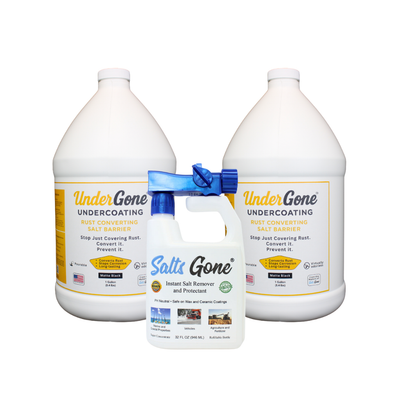
Under Gone™ is engineered for minimal prep. Knock loose rust off with a wire brush, rinse the undercarriage with Salts Gone® to remove soluble chlorides, let it dry, and spray. The built-in rust converter handles the chemical side of prep that POR-15 requires you to do mechanically and with acid. No etching, no multi-product system, no neutralization step, no waiting for a primer coat to dry before the topcoat. This is the difference between a job you can finish in a weekend and a job that takes a full week of evenings.
Rigid Cure vs Flexible Film
POR-15 cures into a rigid, glass-hard shell. On a static frame rail that will be painted, topcoated, and never flexed significantly, this is exactly what you want. On a daily-driven vehicle frame that experiences constant thermal cycling, suspension loads, road impacts, and chassis flex, rigid coatings eventually develop stress cracks. Those cracks are often invisible to the naked eye, but they are entry points for moisture and chlorides to reach the metal — and because the rest of the coating is still intact, the corrosion progresses out of sight beneath the hard shell.
Under Gone™’s calcium sulfonate film is intrinsically flexible because it never fully hardens. It flexes with the substrate through thermal cycling, vibration, and mechanical stress without cracking. Minor stone chips and scuffs self-heal as the surrounding film re-flows to cover the disturbed area. There is no brittle shell to fail, so there is no hidden corrosion to discover at a later inspection. For vehicles that live outside and see winter salt every year, flexible undercoat is simply a better fit for the operating environment than rigid encapsulator.
UV Stability and the Topcoat Requirement
One important property of POR-15 that often surprises first-time users is that it is not UV stable. Uncoated POR-15 degrades in direct sunlight — it chalks, fades, and eventually loses its protective properties. The manufacturer requires a compatible topcoat (such as POR-15 Top Coat or an automotive urethane) over any POR-15 surface that will see sunlight. For frame rails tucked up into an undercarriage, this matters less. For exposed sections, underbody panels, and anything that sees direct sun, it adds yet another product and another application step.
Under Gone™ is UV stable as-applied. There is no topcoat requirement, no second product in the system, and no additional cost or labor for sun-exposed sections. Once it’s on, it’s done — and it stays on without requiring protection from its own base coating.
Isocyanate Fumes and Indoor Application
POR-15’s moisture-cured urethane chemistry releases isocyanate fumes during application and cure. Isocyanates are respiratory sensitizers — they require proper respirator protection (not just a dust mask), ventilated workspace, and extended off-gas time before the space can be used for other work. This is not a reason to avoid POR-15 for the right job, but it does mean the product is not suited for casual indoor garage application, attached-garage shops with living spaces nearby, or professional bays running multiple jobs per day without proper ventilation infrastructure.
Under Gone™ is virtually odorless and safe for indoor application in home garages, enclosed shop bays, and professional facilities without special ventilation. There are no isocyanates, no respirator requirement beyond standard spray hygiene, and no extended off-gas period before the space can be reused. For anyone whose workspace is also adjacent to a home, this is not a minor convenience — it determines whether you can do the job at all without renting an outside facility.
Touch-Ups, Reapplication, and the Maintenance Model
Once POR-15 has cured, it is extremely difficult to touch up or reapply over itself. The rigid cured surface is chemically inert by design, which means fresh POR-15 does not bond reliably to old POR-15. The correct reapplication method is to mechanically abrade or chemically strip the old coating back to a scuffed surface, then start the full three-step system over again. In practice, this means most POR-15 applications are treated as one-and-done — you apply it correctly the first time and hope the conditions never change enough to require rework.
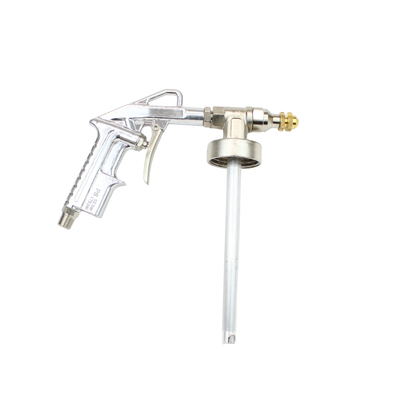
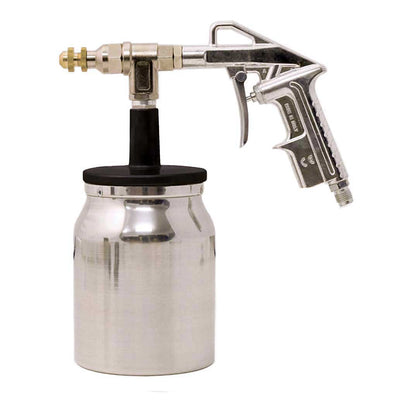
Under Gone™ is built for the maintenance model. Because the calcium sulfonate film never fully hardens, new coating bonds cleanly to existing coating. Annual inspection, spot-treatment of worn areas, and full re-coats in high-impact zones are simple operations — you fill the gun and you spray, same as the original application. There is no stripping, no etching, no priming, and no waiting for multiple stages to cure. For vehicles that will stay in service for many more years, the long-term labor cost of Under Gone™ is dramatically lower than an equivalent POR-15 maintenance schedule.
When POR-15 Is Still the Right Answer
We’re not going to pretend POR-15 is the wrong product for every job. If you’re doing a full frame-off restoration on a classic car, stripping the frame to bare metal, and looking for a permanent encapsulator that will hold up under a fresh topcoat for decades, POR-15 is a legitimately excellent choice. If you’re rebuilding a heavily rusted trailer frame, rock crawler, or project vehicle where the labor of full prep is already baked into the budget, POR-15 will reward that effort with exceptional longevity. The rigid cure that makes it a poor choice for ongoing maintenance is exactly what makes it a good choice for one-time permanent restoration.
For everyone else — daily drivers, winter vehicles, work trucks, fleet rigs, farm equipment, trailers that get used year-round, and anything that will be inspected and maintained annually rather than restored once — Under Gone™ is the simpler, more flexible, more forgiving choice. It’s not trying to be POR-15. It’s trying to be the right answer for the 90% of vehicles that don’t need full restoration, just consistent protection year after year.
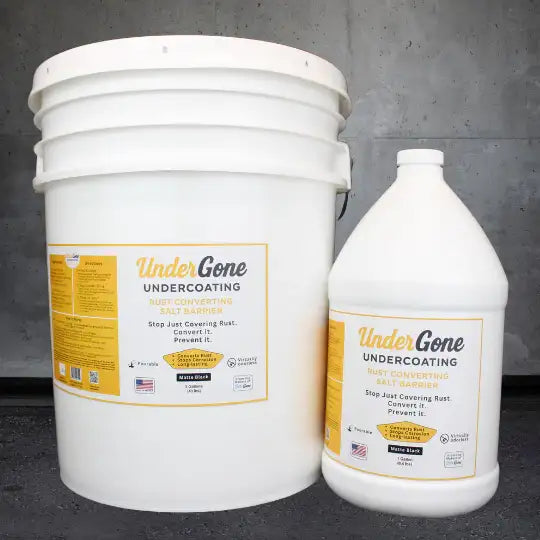
Skip the Acid Etch. Skip the Topcoat. Just Protect the Metal.
Under Gone™ gives you real rust conversion and chemically-bonded protection without the three-product system, the isocyanate fumes, or the rigid cure that cracks under substrate flex. Professional undercoating that works with your maintenance schedule, not against it.
What Our Customers Say
Trusted by boaters, drivers, fleet operators, and homeowners across the country.
This is a must have if you live in the rust belt. I use it on my truck and tractor. It's amazing stuff.
As a coastal homeowner, we are finally able to efficiently protect our property from the corrosive environment around us.
I have been using Salts Gone on my boat and jet ski now for 2 years. Best product I have ever used. Way better than the competitors.
We use Salts Gone on our plow trucks after each snow event and are very happy with the results! Clean trucks with no salt residue left behind.
Best salt fighting product on the market. Honest advertisements unlike the competitor.
What a shocking experience! My pickup is not only showing no signs of salt, it is cleaner than it was before!
Featured Products
Under Gone™ vs POR-15 — Common Questions
Answers to the most frequently asked questions about choosing between POR-15’s restoration system and Under Gone™’s ongoing undercoat.