

Under Gone™ vs Woolwax
Thicker Isn’t the Same as Smarter
Woolwax is the thicker, stickier alternative to Fluid Film — but it’s still just lanolin layered over existing rust. Under Gone™ converts rust at the chemical level with calcium sulfonate technology, then seals it with a salt-barrier grease that bonds to metal. See the side-by-side.
Under Gone™ vs Woolwax — Feature Comparison
Two lanolin-category competitors, two philosophies. Woolwax goes thicker; Under Gone™ goes smarter. Here is how they compare across the criteria that actually determine long-term rust protection.
Under Gone™ vs Woolwax — What the Chemistry Tells Us
Why Woolwax Exists
Woolwax was developed as a direct response to one of the biggest complaints about Fluid Film: dripping. Lanolin-based coatings are thin by nature, and when applied to a warm undercarriage, they can run, drip, and migrate off the target surface before setting up. Woolwax solved that by thickening its lanolin formulation so it clings more aggressively on vertical panels and stays where you spray it. For DIYers and shops tired of re-coating runs and drips, this was a meaningful improvement — and it is why Woolwax has built a strong following in the northeast and Canada where winter-brine corrosion is a constant battle.
But thickening a lanolin film only addresses the application problem. It doesn’t change the fundamental chemistry. Woolwax is still a mechanical coating — it sits on top of the metal, relies on physical contact to stay in place, and does absolutely nothing to address rust that already exists underneath it. Thicker lanolin is better lanolin, but it is still lanolin. That is the limitation Under Gone™ is engineered to overcome.
The Chemistry Gap Thickness Can’t Close
Under Gone™ is built on overbased calcium sulfonate grease combined with a rust converter, which is a fundamentally different class of chemistry than any wool-wax product. The calcium sulfonate base was originally developed for marine bearing and cable lubricants where components are submerged in salt water for years at a time. It bonds chemically to ferrous metal — not just mechanically — and it contains reserve alkalinity that actively neutralizes acidic corrosion byproducts as they form.
The rust converter component is the piece no lanolin product can replicate. When Under Gone™ makes contact with existing iron oxide (Fe₂O₃), it triggers a chemical reaction that transforms the rust into a more stable, chemically inert iron compound. After that reaction completes, the metal beneath the coating is no longer actively corroding — it has been passivated. This is the difference between coating a problem and fixing it. Woolwax, no matter how thick, cannot chemically alter the rust underneath it. It can only slow its progression by blocking oxygen and moisture from reaching the surface.
The Odor & Indoor Application Question
Lanolin is a natural product from sheep’s wool, and it carries a distinctive smell that some users find pleasant, some tolerate, and many actively dislike. Woolwax, because of its thicker formulation, can actually have a stronger lanolin aroma than Fluid Film depending on the batch and the carrier solvents used to thin it for spraying. For shops that work in enclosed bays, indoor facilities, or garages attached to living spaces, the lingering smell is a real operational consideration.
Under Gone™ is virtually odorless in application and storage. It does not emit the characteristic wool-oil aroma associated with lanolin products, and it can be applied in indoor shops, home garages, and enclosed workspaces without concerns about odor migration into adjacent rooms or vehicle interiors. For professional applicators running multiple jobs per day, this is not a minor quality-of-life improvement — it affects customer experience, shop comfort, and whether the work can be done year-round without ventilation constraints.
Application Temperature and Viscosity
Woolwax’s thicker formulation can require heating or thinning in colder temperatures to flow properly through an undercoating gun. Many professional Woolwax users keep a heated gun station or a warming box to maintain spray consistency during winter application season. It is a workable process, but it adds equipment and setup time to every job.
Under Gone™ is formulated to spray cleanly at normal shop temperatures without pre-heating, and its viscosity remains consistent through typical working ranges. For shops that want to run undercoat jobs without dedicated heating equipment — or for DIYers applying at home in a cool garage — this is a meaningful simplification. You fill the gun and you spray.
The Case for Under Gone™
Woolwax is a legitimately better product than basic Fluid Film for anyone who values reduced dripping and stronger cling on vertical panels. It has earned its reputation. But the comparison to Under Gone™ comes down to one question: do you want a product that coats rust better, or a product that converts it and seals it with a chemically-bonded film? Under Gone™ is the answer to the second question. It is priced in the same category, it sprays without heating, it bonds chemically to metal, and it leaves no lanolin odor behind. For vehicles with any existing rust, the gap isn’t subtle.
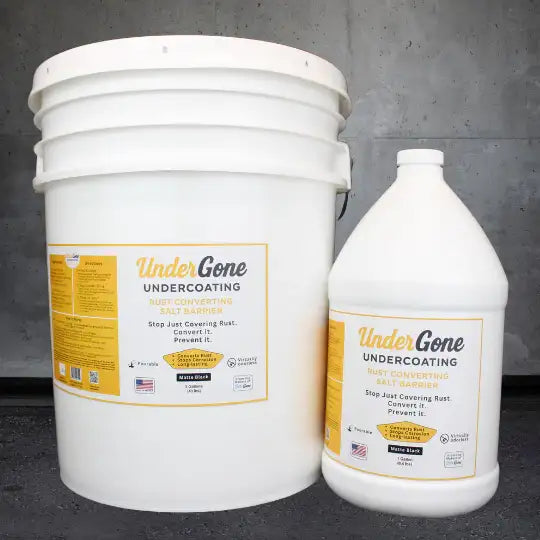
Thicker Lanolin Is Still Just Lanolin.
Under Gone™ uses calcium sulfonate chemistry and a rust converter to chemically neutralize existing corrosion, then seals it with a chemically-bonded salt barrier. One product, real conversion, no wool-oil smell. Ready to upgrade your next undercoat?
What Our Customers Say
Trusted by boaters, drivers, fleet operators, and homeowners across the country.
This is a must have if you live in the rust belt. I use it on my truck and tractor. It's amazing stuff.
As a coastal homeowner, we are finally able to efficiently protect our property from the corrosive environment around us.
I have been using Salts Gone on my boat and jet ski now for 2 years. Best product I have ever used. Way better than the competitors.
We use Salts Gone on our plow trucks after each snow event and are very happy with the results! Clean trucks with no salt residue left behind.
Best salt fighting product on the market. Honest advertisements unlike the competitor.
What a shocking experience! My pickup is not only showing no signs of salt, it is cleaner than it was before!
Featured Products
Under Gone™ vs Woolwax — Common Questions
Answers to the most frequently asked questions about switching from Woolwax to Under Gone™.