

Under Gone™ vs 3M Rubberized Undercoating
Why Hard Coatings Trap the Problem
3M’s rubberized aerosol cures into a rigid shell — and if any moisture, salt, or rust is underneath it when you spray, the corrosion keeps spreading beneath the coating where you can’t see it. Under Gone™ never hardens, converts rust on contact, and bonds chemically to metal. Here’s the comparison.
Under Gone™ vs 3M Rubberized — Feature Comparison
Rubberized aerosols are the cheapest undercoat option on the shelf. That convenience comes with real trade-offs when it comes to long-term rust protection. Here’s how they compare on the criteria that matter.
Under Gone™ vs 3M Rubberized — Why Hard Coatings Fail Over Time
The Rubberized Undercoating Problem
Walk into any auto parts store and you’ll see a wall of rubberized undercoating aerosols — 3M, Rust-Oleum, Dupli-Color, POR-15’s version, and a dozen private-label options. They’re cheap, they’re convenient, and they look professional when they cure into a black rubber-like shell on an undercarriage. They are also, for most applications, the wrong tool for the job. The issue isn’t marketing — it’s chemistry and physics.
Rubberized undercoatings are topical barrier coatings. They form a thick, opaque shell that sits on top of the metal. When applied to a perfectly clean, perfectly dry, rust-free substrate and never disturbed, they can provide reasonable short-term protection. The problem is that real-world undercarriages are almost never perfectly clean, perfectly dry, or rust-free — and rubberized coatings are extremely unforgiving of any contamination trapped beneath them.
The Moisture Trap
When rubberized coating is sprayed over a surface that has any residual moisture, salt, or surface rust, it seals those contaminants against the metal. The hard shell creates an oxygen-poor microenvironment underneath it, but the residual water, chlorides, and active iron oxide are still there — and corrosion continues beneath the coating. Because the rubberized shell is visually opaque, you can’t see the damage progressing. By the time the coating begins to lift, blister, or crack, the metal underneath is often significantly worse than it was before the coating was applied.
This is the core argument against rubberized coatings for daily drivers, older vehicles, fleet trucks, and anything that sees real winter weather. They create a situation where not applying any coating would have been the safer choice. The owner thinks the vehicle is protected; the rust says otherwise.
Under Gone™ solves this problem in two ways. First, its rust converter chemically reacts with any iron oxide on the metal surface, transforming active rust into a stable, inert compound before the protective film sets up. Second, Under Gone™ never fully hardens. It remains a flexible, greasy, hydrophobic film that physically displaces moisture from the metal surface instead of sealing moisture in. If water or road brine makes its way behind the film at a seam or edge, the film itself repels the water rather than trapping it.
Flex, Cracks, and the Reality of Vehicle Substrates
Vehicle frames and panels flex constantly. Road impacts, suspension loads, thermal expansion, weight transfer under braking — all of these put cyclical stress on the metal beneath any undercoating. A rigid rubberized coating flexes with the metal up to a point, then begins to micro-crack. Those hairline cracks are not always visible to the naked eye, but they are highways for water and dissolved chlorides to reach the substrate underneath.
Under Gone™’s calcium sulfonate film is intrinsically flexible. It does not crack under substrate flex because it doesn’t cure into a rigid state in the first place. It maintains full-coverage protection through thermal cycling, vibration, and mechanical stress that would compromise a hardened coating. Minor mechanical damage — a stone chip, a scrape from loading debris, brake dust scouring — self-heals because the surrounding film re-flows slightly to cover the disturbed area.
Coverage and Cost Reality
Rubberized aerosols look cheap on the shelf. A can is usually priced at around $10, and it seems like a bargain compared to professional undercoating. But aerosols cover very little surface area. A single can typically treats roughly one wheel well or one small section of frame rail. Coating an entire truck or SUV undercarriage — frame, floor pans, inner fenders, wheel wells, exhaust tunnel — commonly requires 6 to 12 cans. That’s $60–$120 of aerosol product for a single application, applied inefficiently, with significant overspray waste and no ability to tailor the coating thickness where it matters most.
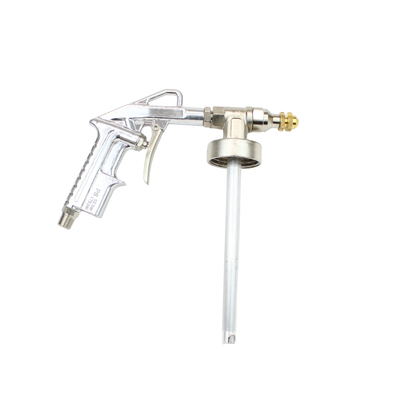
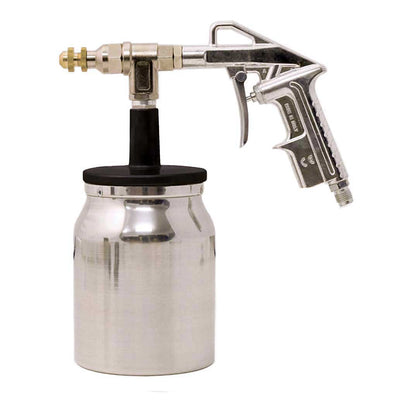
Under Gone™ is sold in 1-gallon, 5-gallon, and 55-gallon containers specifically because professional undercoat jobs and serious DIY applications require real volume. A gallon of Under Gone™ is enough to fully coat most undercarriages with proper coverage for the high-risk zones. The per-vehicle cost is lower than equivalent aerosol coverage, the application is more controlled through a dedicated undercoat gun, and the product can be reapplied annually to high-wear areas without buying a new bulk inventory each time.
When a Rubberized Coating Still Makes Sense
We’ll be honest: rubberized aerosols do have legitimate use cases. If you’re spot-treating a small section of bare metal on a show car that lives in a climate-controlled garage and never sees winter weather, a rubberized can is a reasonable choice. If you’re adding extra sound deadening on top of an existing undercoat, rubberized aerosol is cheap and looks clean. But for daily-driven vehicles, winter drivers, fleet trucks, off-roaders, trailers, farm equipment, and anything with existing surface rust, a rigid shell coating is the wrong philosophy. You need a product that converts rust, bonds chemically to the metal, and stays flexible through years of real-world abuse. That’s what Under Gone™ is engineered to do.
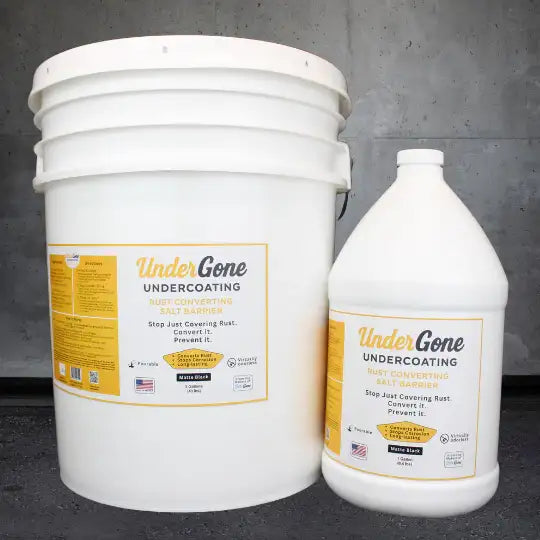
Stop Sealing Rust Inside a Rubber Shell.
Under Gone™ converts existing rust at the chemical level, bonds to metal, and stays flexible for the life of the vehicle. No cracking, no peeling, no hidden corrosion spreading beneath a hard coating. Professional-grade undercoating, real protection, available in 1 gal, 5 gal, and 55 gal.
What Our Customers Say
Trusted by boaters, drivers, fleet operators, and homeowners across the country.
This is a must have if you live in the rust belt. I use it on my truck and tractor. It's amazing stuff.
As a coastal homeowner, we are finally able to efficiently protect our property from the corrosive environment around us.
I have been using Salts Gone on my boat and jet ski now for 2 years. Best product I have ever used. Way better than the competitors.
We use Salts Gone on our plow trucks after each snow event and are very happy with the results! Clean trucks with no salt residue left behind.
Best salt fighting product on the market. Honest advertisements unlike the competitor.
What a shocking experience! My pickup is not only showing no signs of salt, it is cleaner than it was before!
Featured Products
Under Gone™ vs 3M Rubberized — Common Questions
Answers to the most frequently asked questions about choosing between rubberized aerosol undercoatings and Under Gone™.