Undercoating/Paint Combo Kits

Starter Kits Make Rust-Converting Easy

Don’t just cover rust — convert it, then protect it. Whether you want a soft, flexible undercoat, or a durable paint, we've got you covered.
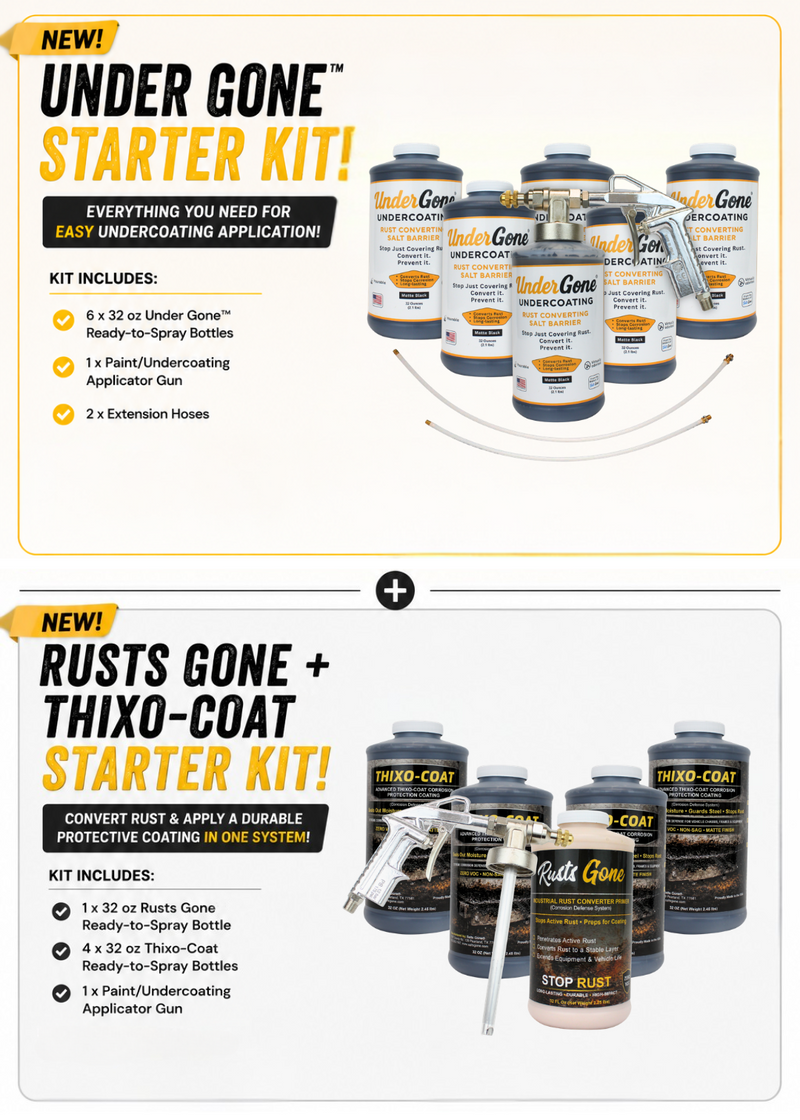
Undercoating/Paint Combo Kits
The Problem

Undercoatings aren’t fixing rust, they’re just slapping a band-aid on it!

Ordinary paints and traditional undercoatings — whether lanolin, wax, or oil-based — simply cover existing rust without addressing the underlying corrosion. Moisture gets trapped underneath, and the rust continues to eat away at the metal from the inside out.

That means you’re paying good money to hide a problem that’s only getting worse.

The Solution

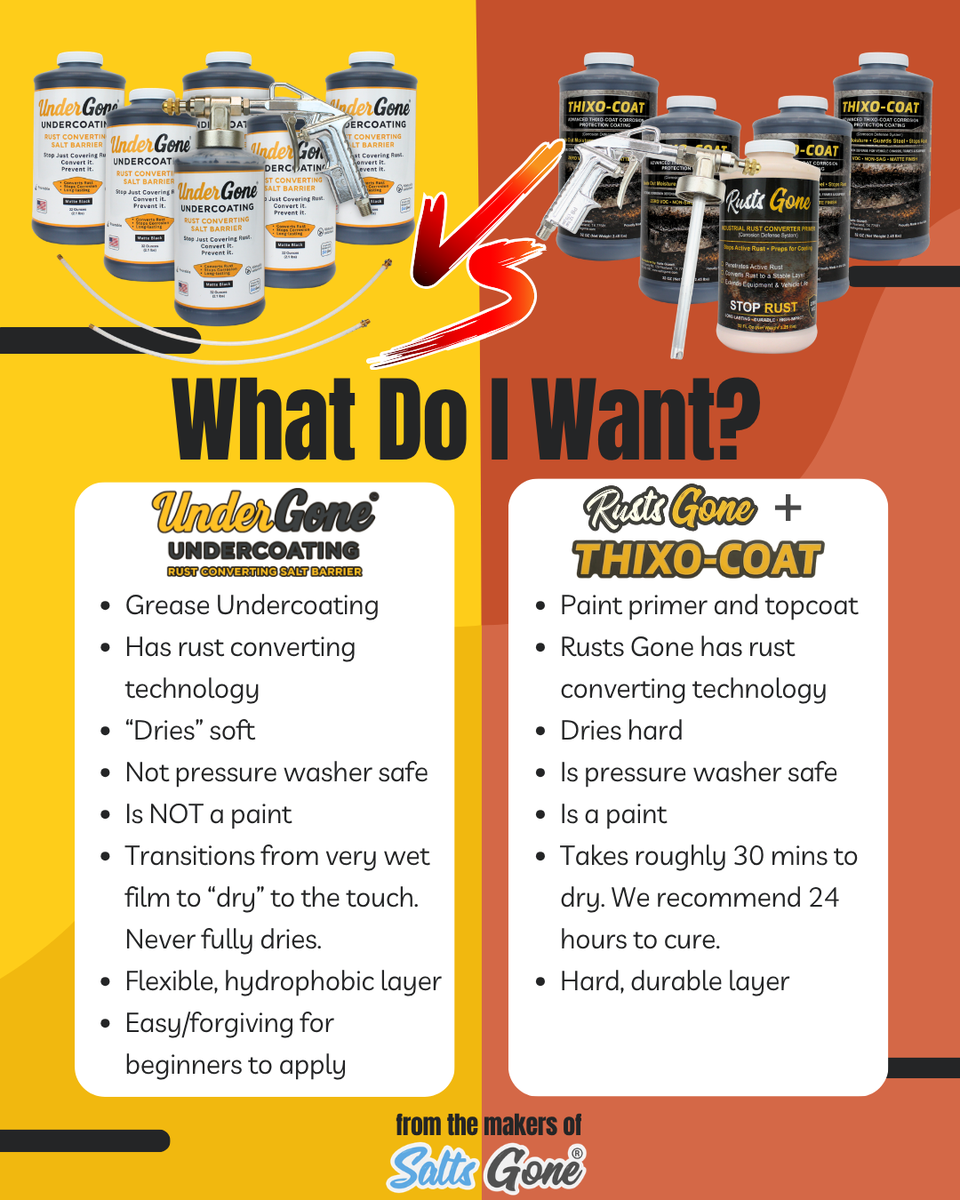
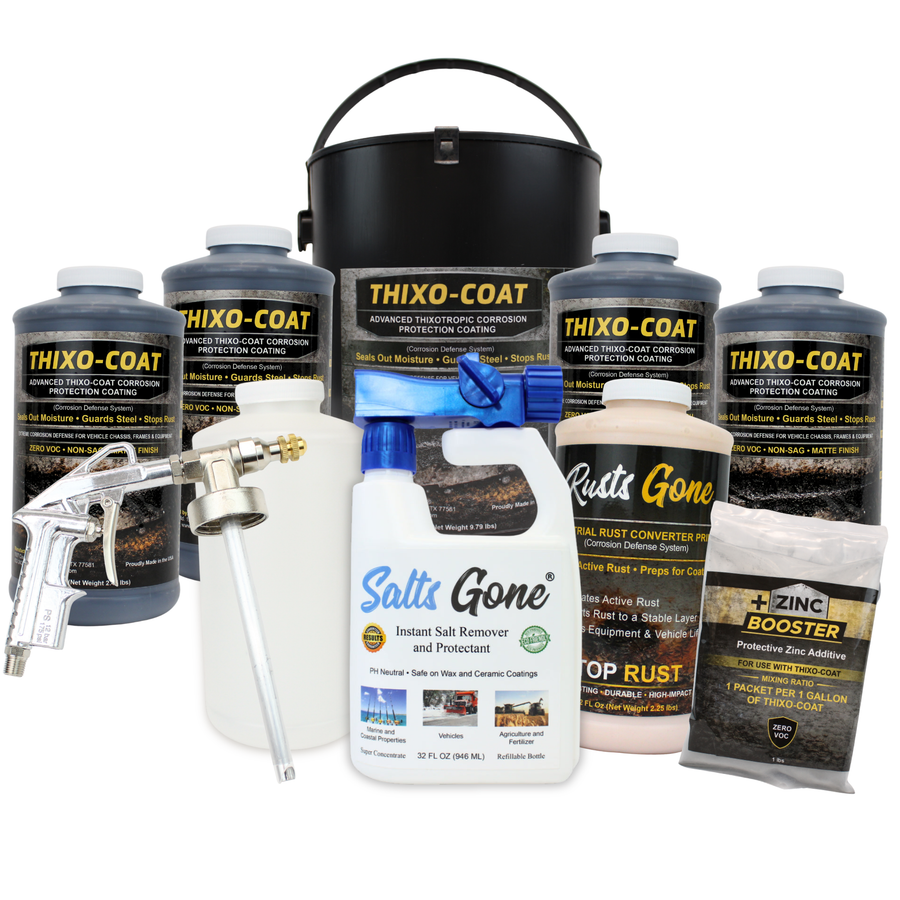
Stop hiding rust and start eliminating it. Our new combo packs give you the power to choose the exact rust-killing defense your vehicle needs. Whether you prefer a flexible grease undercoating or a rock-hard painted shield, both systems chemically convert iron oxide to stop rust dead in its tracks.
Undercoatings aren’t fixing rust, they’re just slapping a band-aid on it!

Convert and Protect

Watch how our Under Gone™ and Rusts Gone/Thixo-Coat convert rust and protect metal in real-world applications.

Frequently Asked Questions

Everything you need to know about Under Gone™ Undercoating.

Under Gone™ is a Rust Converting Salt Barrier that not only protects your vehicle from corrosion but also chemically converts existing rust into a stable, protective layer (it actually passivates metal).
Under Gone™ uses advanced calcium sulfonate chemistry with conventional rust converters to react with rust at the surface, stabilizing it into an inert layer. This process both halts further corrosion and creates a base for the protective barrier that blocks salt, brine, and moisture.
Traditional coatings mainly cover rust without stopping its spread. Under Gone™ stands out because it is a rust converter and corrosion inhibitor in one, delivering stronger adhesion, better salt resistance, and longer-lasting performance under harsh driving conditions.
No, Under Gone™ is not a paint, and it won’t harden like one. It’s a water-based grease undercoating that lightly dries as the water evaporates, but it will always remain greasy to the touch. This is by design, as it forms a highly hydrophobic barrier that prevents salt and moisture from ever reaching the metal surface.
Yes. Under Gone™ is specifically designed to convert and stabilize existing rust before sealing it. For best results, remove loose or flaking rust and rinse with Salts Gone® to eliminate soluble chlorides prior to application.
Under Gone™ can be applied using an undercoating gun, sprayer, or brush. Simply prep the surface and apply evenly.
Under Gone™ is built for long-term adhesion and durability, resisting wash-off, heat, and pressure. The product should be allowed to cure before heavy use. Annual inspection and touch-ups in high-wear areas are recommended for maximum longevity.
Yes. Unlike strong-smelling lanolin or solvent-based coatings, Under Gone™ is virtually odorless and safe to use in a garage or shop setting with standard ventilation.
Absolutely. Under Gone™ is ideal for trailers, off-road vehicles, farm equipment, fleets, and classic cars — anywhere rust and salt exposure is a concern.
Under Gone™ is available in 1 gallon, 5 gallon pails, and 55 gallon drums, making it ideal for DIY users, automotive shops, and fleet operators alike.
Under Gone™ is manufactured in Houston, Texas, USA by Custom Chemicals & Coatings. We take pride in producing high-quality, American-made undercoating solutions that deliver real results.

Frequently Asked Questions

Everything you need to know about Rusts Gone Primer.

Rusts Gone is designed for use on iron, steel, and cast iron surfaces. It is not recommended for aluminum, stainless steel, chrome, or painted surfaces without first testing on a small, inconspicuous area. The tannic acid formula is specifically formulated to react with iron oxide, so it works best on ferrous metals where rust has formed.
Apply Rusts Gone and allow a full 24-hour cure time. Do not rinse. The tannic acid needs time to fully react with and convert the iron oxide into stable iron tannate. You'll see the surface darken as conversion progresses. For heavy, flaking rust, wire wheel loose scale first, then apply. Severely rusted surfaces may benefit from a second coat after the first has fully cured.
You only need to remove loose, flaking scale that is already detached from the surface. A quick pass with a wire brush or scraper to knock off heavy flakes is all that is needed. The chemical formula does the real work of converting the rust that is still bonded to the metal — no heavy sanding or grinding required.
Yes — that's exactly what it's designed for. After a full 24-hour cure, the iron tannate layer provides excellent adhesion for primers, paints, and protective coatings. No sanding or rinsing needed. Apply your topcoat directly over the cured surface.
Yes. If the surface has been exposed to road salt, ocean spray, or de-icing chemicals, apply Salts Gone® first to remove all salt contamination. Salt residue can interfere with the rust conversion process and reduce Rusts Gone's effectiveness. Once Salts Gone® has been applied and rinsed, allow the surface to dry before applying Rusts Gone to the rusted areas.
Rusts Gone can be used indoors as long as you ensure adequate ventilation. Open windows and doors, or use fans to maintain airflow in the work area. Always wear chemical-resistant gloves and safety glasses or goggles when applying. While Rusts Gone is significantly safer than muriatic acid and other aggressive rust removers, the tannic acid formula does produce mild fumes that should not be inhaled in enclosed spaces.
Rusts Gone offers several advantages over traditional naval jelly. It converts rust through a tannic acid reaction rather than relying on phosphoric acid gel. It is easier to apply — spray or brush it onto large areas instead of spreading thick gel. It is far less messy, with no sticky residue to clean up. And it creates a stable iron tannate surface ready for topcoat after a 24-hour cure — no rinsing required.

Frequently Asked Questions

Everything you need to know about Thixo-Coat Paint.

Thixotropic describes a material that becomes thinner (less viscous) when force is applied and thicker when at rest. Think of it like ketchup — it stays in the bottle until you shake it. Thixo-Coat flows easily during application but sets up firm once in place. This lets it penetrate tight spaces while staying put on vertical surfaces.
The biggest difference comes down to the type of finish they provide and how they cure. Under Gone™ is a flexible, grease-based undercoating. It transitions to a "dry to the touch" film but never fully hardens, meaning it dries soft. Thixo-Coat, on the other hand, is a true paint designed to act as a heavy-duty topcoat that dries into a hard, highly durable layer.
For best results, treat existing rust with Rusts Gone first to convert it into a stable surface. Thixo-Coat can be applied over light surface rust in a pinch, but heavily rusted surfaces should be converted first for maximum adhesion and long-term protection.
Use an injection wand inserted through existing drain holes or access points. Inject the product into the cavity and it will self-level to coat interior surfaces. For door panels, access through the drain holes at the bottom of the door. For box-section frame rails, drill a small access hole, inject, then plug the hole.
Yes, Thixo-Coat cures hard but remains semi-flexible. It never becomes brittle. This is by design — the flexibility allows it to move with the vehicle’s body as it flexes, vibrates, and expands/contracts with temperature changes without cracking or losing adhesion.
Yes. Once cured, Thixo-Coat can be overcoated with Under Gone™, most automotive primers and paints, or industrial coatings. For seam applications that will be visible, you can topcoat for a finished appearance. For hidden cavity applications, no topcoat is necessary.
In enclosed cavities and protected areas, Thixo-Coat provides multi-season protection and can last years. Exposed applications may need periodic inspection and touch-up depending on environmental severity. The product is easily reapplied — new product bonds to existing Thixo-Coat without stripping.