

Chelation Technology -
How Salts Gone® Removes Salt at the Ion Level
Unlike traditional soap or water rinses, Salts Gone® uses chelation — a proven chemical process that bonds to salt ions at a molecular level, removes them permanently, and prevents recrystallization.
How Chelation Removes Salt
A four-stage molecular process that eliminates salt — not just displaces it.
Contact
Salts Gone’s® chelating agents make contact with salt deposits (NaCl). The formula penetrates crystalline salt structures and reaches ions bonded to the surface.
Ion Capture
Chelating molecules form coordinate covalent bonds with Na⁺ and Cl⁻ ions. Each chelator wraps around the ion like a molecular claw (Greek: chele = claw), sequestering it.
Bond Breaking
The chelation reaction breaks the ionic bonds within the salt itself. The salt's molecular structure is dismantled as individual ions are pulled into stable, water-soluble chelate complexes that cannot reform or reattach to surfaces.
Complete Removal
Chelated salt complexes rinse away with water, leaving a clean surface with a thin protective barrier. Unlike water alone, chelated ions cannot recrystallize.
What Makes Chelation Work
Three active components working at the molecular level to eliminate salt and protect surfaces.
Advanced Chelating Agents
Salts Gone®'s patented formula uses chelating agents that form hexadentate complexes with metal ions. Each molecule has six binding sites, creating exceptionally stable chelate rings that permanently sequester sodium, calcium, and magnesium ions from salt deposits.
Sequestration Agents
Secondary chelating agents target divalent ions (Ca²⁺, Mg²⁺) found in road brine and hard water deposits. These agents form thermodynamically stable complexes with formation constants (Kf) exceeding 10¹⁰, ensuring captured ions cannot release back onto surfaces.
Surface Passivation
After chelation removes ionic contaminants, corrosion-inhibiting compounds remain on the substrate as a light residual film. This film helps resist future salt adhesion and slows the onset of corrosion between treatments.
Chelation vs. Traditional Washing
Water moves salt around. Chelation eliminates it.
Understanding Chelation Chemistry
What Is Chelation?
The word chelation comes from the Greek word chele, meaning claw. It is an apt description: chelating agents are molecules that reach out and grip metal ions with multiple bonding sites, forming a ring-like structure that completely surrounds and sequesters the target ion. This process — called chelation — is one of the most powerful and well-understood reactions in chemistry, and it is the core technology behind every Salts Gone® product.
In a chelation reaction, a single chelating molecule donates multiple pairs of electrons to a metal ion, forming what chemists call coordinate covalent bonds. The result is a remarkably stable complex known as a chelate. Once an ion is captured inside a chelate complex, it is effectively neutralized — unable to bond with surfaces, unable to cause corrosion, and unable to recrystallize when water evaporates.
A Proven Technology with Deep Roots
Chelation is not new or experimental. It has been used in industrial and scientific applications for nearly a century. Municipal water treatment plants use chelating agents to remove heavy metals and mineral deposits from drinking water. In medicine, chelation therapy is an FDA-approved treatment for heavy metal poisoning, where chelating agents bind to lead, mercury, or arsenic in the bloodstream and allow the body to excrete them safely. The food industry relies on chelating agents as preservatives that bind trace metal ions to prevent oxidation and spoilage. Salts Gone® brings this same proven chemistry to the problem of salt contamination on vehicles, boats, equipment, and property.
The Chemistry: How Chelating Agents Bond with Salt Ions
Table salt — sodium chloride (NaCl) — dissolves in water into its component ions: positively charged sodium (Na⁺) and negatively charged chloride (Cl⁻). These ions are small, highly reactive, and eager to bond with metal surfaces, which is why salt accelerates corrosion so aggressively. When Salts Gone® is applied, its chelating agents immediately begin forming coordinate bonds with these ions. Salts Gone®'s patented chelators are <strong>hexadentate</strong> ligands — each molecule has six electron-donor sites that wrap around a metal ion and lock it in place. When the chelator bonds to a salt ion, it breaks the ionic bonds that hold the salt together as a compound. The salt's molecular structure is dismantled — sodium separates from chloride, calcium separates from chloride — and each ion is individually captured inside a chelate ring. The resulting complexes are extraordinarily stable, with formation constants (Kf) that can exceed 10¹⁰ for divalent cations. This thermodynamic stability means the reaction is essentially irreversible under normal conditions.
Beyond Table Salt: The Road Brine Problem
While sodium chloride gets the most attention, it is only part of the salt contamination problem. Modern road deicing programs increasingly use calcium chloride (CaCl₂) and magnesium chloride (MgCl₂) as de-icing agents because they are effective at lower temperatures and generate heat as they dissolve. However, these divalent salts are significantly harder to remove than simple NaCl. Calcium and magnesium ions form stronger bonds with metal and concrete surfaces, and they leave behind stubborn white residues that resist water rinsing. Salts Gone’s® formula includes secondary chelating agents specifically designed to target these divalent ions, forming stable complexes that lift them off surfaces completely.
Why Water Alone Fails: Dissolution vs. Chelation
When you rinse a salty surface with water, you are relying on dissolution — the process of dissolving salt crystals into solution. This works to a point: water is an excellent solvent for NaCl. But dissolution has a fatal flaw. As the rinse water evaporates, the dissolved salt ions come back out of solution and recrystallize on the surface. The salt is not destroyed or neutralized — it is simply moved, and it returns as soon as conditions change. Chelation is fundamentally different. When a chelating agent captures a salt ion, it forms a new, stable molecular complex. That complex remains in solution and rinses away permanently. Even if the rinse water evaporates, the chelated ions cannot release from their molecular cage to reform salt crystals. This is the key distinction: dissolution is temporary, chelation is permanent.
The Role of Surfactants in the Chelation Process
Chelating agents alone are powerful, but they work even better when paired with advanced surfactants. Surfactants lower the surface tension of water, allowing the chelation solution to spread more evenly and penetrate into micro-pores, crevices, and textured surfaces where salt accumulates. Without surfactants, a chelation solution might bead up on a waxed or coated surface and miss the salt deposits hiding in surface imperfections. Salts Gone’s® surfactant package ensures complete contact between the chelating agents and every salt deposit on the treated surface, maximizing the efficiency of the chelation reaction.
How the Protective Barrier Forms
After chelation has removed salt ions and the surface is rinsed clean, Salts Gone® leaves behind a thin, invisible layer of corrosion-inhibiting compounds. These passivating agents bond to the substrate at a molecular level, creating a hydrophobic nanoscale barrier that repels water and dissolved salts. This barrier does not change the appearance or texture of the surface, but it dramatically slows the rate at which new salt deposits can form and adhere. The result is a surface that stays cleaner longer and resists corrosion between treatments.
Real-World Applications of Chelation Technology
Salts Gone’s® chelation formula is used across a wide range of industries and applications. Automotive owners use it to protect vehicles from road salt and brine. Marine operators treat boats, trailers, and dock hardware exposed to saltwater. Aviation maintenance crews apply it to aircraft and ground support equipment. Municipalities use it on fleet vehicles, snowplows, and spreaders. Coastal homeowners treat outdoor furniture, railings, HVAC systems, and concrete surfaces. In every case, the underlying chemistry is the same: chelation captures salt ions at a molecular level, removes them permanently, and leaves a protective barrier to slow future contamination. It is the most effective salt removal technology available, backed by decades of proven science.
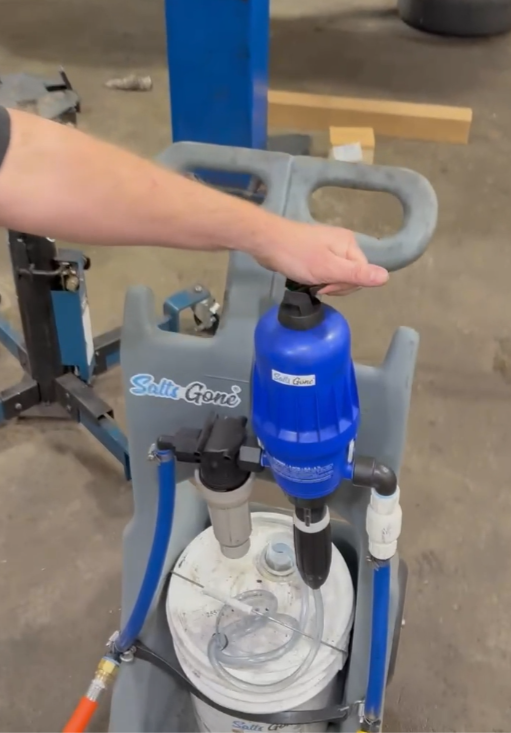
Experience Chelation Technology
See the science in action. Try Salts Gone® on any surface and watch salt disappear at a molecular level.
What Our Customers Say
Trusted by boaters, drivers, fleet operators, and homeowners across the country.
This is a must have if you live in the rust belt. I use it on my truck and tractor. It's amazing stuff.
As a coastal homeowner, we are finally able to efficiently protect our property from the corrosive environment around us.
I have been using Salts Gone on my boat and jet ski now for 2 years. Best product I have ever used. Way better than the competitors.
We use Salts Gone on our plow trucks after each snow event and are very happy with the results! Clean trucks with no salt residue left behind.
Best salt fighting product on the market. Honest advertisements unlike the competitor.
What a shocking experience! My pickup is not only showing no signs of salt, it is cleaner than it was before!


Chelation Technology Questions
Understanding the science behind Salts Gone.